


Summary of How to interface Stepper Motor with PIC18F4550 Microcontroller- (Part 13/25)
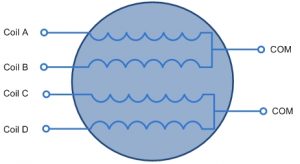
This article explains how to interface a unipolar stepper motor with a PIC18F4550 microcontroller. It details the motor's construction, including four stators and six wire ends, and describes the sequential voltage signals required for rotation. The project utilizes a C program to send specific binary patterns (1110, 1101, 1011, 0111) via PortB to control the motor steps. While the microcontroller can drive the motor directly, using a ULN2003 driver is recommended for better efficiency.Parts used in the Stepper Motor Interface Project:
- Unipolar Stepper Motor
- PIC18F4550 Microcontroller
- ULN2003 Driver (Optional)
- 12V Power Supply
- PortB Pins
Project Source Code
###
// Program to Interface Stepper Motor with PIC18F4550 Microcontroller
void main()
{
unsigned int i=0;
TRISB=0; // Set PortB as output port
while(1)
{
LATB=0x07; // To send 1110 at PortB
Delay_ms(20);
LATB=0x0B; // To send 1101 at PortB
Delay_ms(20);
LATB=0x0D; // To send 1011 at PortB
Delay_ms(20);
LATB=0x0E; // To send 0111 at PortB
Delay_ms(20);
}
}
###
Source: How to interface Stepper Motor with PIC18F4550 Microcontroller- (Part 13/25)
Quick Solutions to Questions related to Stepper Motor Interface Project:
- What is a stepper motor?
A brushless synchronous DC motor that divides a full rotation into a number of steps. - How many wires does a unipolar stepper motor have?
A unipolar stepper motor consists of total 6 wire-ends. - How do you rotate the rotor of a stepper motor?
Zero voltage is provided at coil-ends one by one in a sequential manner. - What sequence does the PIC18F4550 send to rotate the motor?
A repetitive sequence of 1110, 1101, 1011 and 0111 is sent to its PortB pins. - Why is a current driver like ULN2003 used?
It becomes more efficient to employ a current driver between the controller and motor. - How is PortB configured in the source code?
TRISB=0 sets PortB as an output port. - What happens if a stepper motor has a step angle of 1.8 degrees?
It would need 200 steps for a complete circular rotation. - Where are the COM terminals connected?
The COMs are connected with +12V which is the power supply to drive the stepper motor.
Related projects
PICDEM FS USB CDC Evaluation Board using PIC18F4550 with Proteus Simulation
Introduction The PICDEM FS USB CDC Evaluation Board is a practical microcontroller project built around the PIC18F4550, designed to demonstrate USB communication...
Peripheral Tutorials · PIC18F4550PICDEM FS USB Mass Storage Device using PIC18F4550 with Proteus Simulation
Introduction This microcontroller project demonstrates how to simulate a USB Mass Storage Device (MSD) using the PIC18F4550 in a Proteus simulation environment....
Development Boards & Kits · PIC18F2550Pinguino Project: A PIC Microcontroller Based Arduino
This is a complete tutorial to make a PIC Microcontroller based Arduino. This is a complete tutorial to make PIC microcontroller based...
Motors & RoboticsReal-Time CAN-Based Vehicle Monitoring System with PIC MCU
INTRODUCTION The Controller Area Network (CAN) is a robust vehicle communication bus standard that was primarily developed for automobile applications but has...
Motors & RoboticsEasy Way to Learn Robotics Using Microcontrollers: A Beginner’s Guide
The title, "Easy Way to Learn Robotics Using Microcontrollers," promises an accessible entry point for those curious about the exciting world of...
Motors & Robotics · PIC16F877AEfficient Sun-Following Robot: A Solar Tracker with Microcontroller Control
Abstract The impending global challenge of dwindling non-renewable fuel resources underscores the urgency of transitioning towards renewable energy alternatives like solar power....

Muhammad Bilal
I am a highly skilled and motivated individual with a Master's degree in Computer Science. I have extensive experience in technical writing and a deep understanding of SEO practices.