


Summary of How to display text on 16×2 LCD using PIC18F4550 Microcontroller
This article details the process of displaying text messages on a 16x2 LCD using a PIC18F4550 microcontroller. It outlines programming steps involving LCD configuration, string storage in a character array, and iterative character transmission via the `lcddata()` function within a loop. The provided C code initializes ports, sets up the LCD in 8-bit mode, and displays the string "EngineersGarage" with a delay between characters.Parts used in the Display Text on 16x2 LCD Project:
- LCD
- PIC18F4550 Microcontroller
- Preset
Code:
while(data[i]!=’’)
{
lcddata(data[i]);
i++;
Delay_ms(300);
}
Project Source Code
###
// Program to display text on 16x2 LCD using PIC18F4550 Microcontroller
// Configuration bits
/* _CPUDIV_OSC1_PLL2_1L, // Divide clock by 2
_FOSC_HS_1H, // Select High Speed (HS) oscillator
_WDT_OFF_2H, // Watchdog Timer off
MCLRE_ON_3H // Master Clear on
*/
//LCD Control pins
#define rs LATA.F0
#define rw LATA.F1
#define en LATA.F2
//LCD Data pins
#define lcdport LATB
void lcd_ini();
void lcdcmd(unsigned char);
void lcddata(unsigned char);
unsigned char data[20]="EngineersGarage";
unsigned int i=0;
void main(void)
{
TRISA=0; // Configure Port A as output port
LATA=0;
TRISB=0; // Configure Port B as output port
LATB=0;
lcd_ini(); // LCD initialization
while(data[i]!='')
{
lcddata(data[i]); // Call lcddata function to send characters
// one by one from "data" array
i++;
Delay_ms(300);
}
}
void lcd_ini()
{
lcdcmd(0x38); // Configure the LCD in 8-bit mode, 2 line and 5x7 font
lcdcmd(0x0C); // Display On and Cursor Off
lcdcmd(0x01); // Clear display screen
lcdcmd(0x06); // Increment cursor
lcdcmd(0x80); // Set cursor position to 1st line, 1st column
}
void lcdcmd(unsigned char cmdout)
{
lcdport=cmdout; //Send command to lcdport=PORTB
rs=0;
rw=0;
en=1;
Delay_ms(10);
en=0;
}
void lcddata(unsigned char dataout)
{
lcdport=dataout; //Send data to lcdport=PORTB
rs=1;
rw=0;
en=1;
Delay_ms(10);
en=0;
}
###
Circuit Diagrams
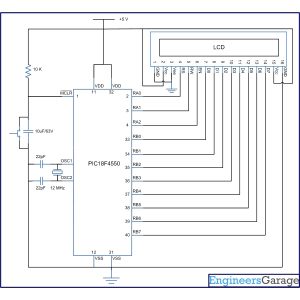
Project Components
Project Video
Source: How to display text on 16×2 LCD using PIC18F4550 Microcontroller
Quick Solutions to Questions related to Display Text on 16x2 LCD Project:
- How is the string stored for display?
A string is stored in a character array named data. - What function sends individual characters to the LCD?
The lcddata() function is used to send individual character values. - How does the program know when to stop displaying characters?
The loop runs until the loop counter encounters the null character of the string. - Which oscillator is selected in the configuration bits?
The High Speed (HS) oscillator is selected. - What is the delay time set between displaying characters?
A delay of 300 milliseconds is used between each character. - How are Port A and Port B configured?
Both Port A and Port B are configured as output ports. - What command configures the LCD in 8-bit mode?
The command 0x38 configures the LCD in 8-bit mode, 2 line, and 5x7 font. - Where does the cursor start after initialization?
The cursor position is set to the 1st line and 1st column.
Related projects
PICDEM FS USB CDC Evaluation Board using PIC18F4550 with Proteus Simulation
Introduction The PICDEM FS USB CDC Evaluation Board is a practical microcontroller project built around the PIC18F4550, designed to demonstrate USB communication...
Peripheral Tutorials · PIC18F4550PICDEM FS USB Mass Storage Device using PIC18F4550 with Proteus Simulation
Introduction This microcontroller project demonstrates how to simulate a USB Mass Storage Device (MSD) using the PIC18F4550 in a Proteus simulation environment....
Development Boards & Kits · PIC18F2550Pinguino Project: A PIC Microcontroller Based Arduino
This is a complete tutorial to make a PIC Microcontroller based Arduino. This is a complete tutorial to make PIC microcontroller based...
LCD & Display ProjectsLeveraging Blockout Banners for Effective Electronics and Tech Product Displays
Blockout banners have become a popular and effective tool for displaying electronics and tech products in various settings, from trade shows and...
LCD & Display Projects · PIC18F4520Interfacing PIC18F4520 microcontroller with an HD44780 LCD
Introduction Being able to display data from a microcontroller visually has many advantages. It allows for menus, status indicators, and instructions to...
LCD & Display ProjectsVideo Project Development in the Midst of an Impromptu Online Semester
Receiving robot parts in the mail was an unexpected conclusion to the Winter 2020 semester for students. However, when faced with a...

Muhammad Bilal
I am a highly skilled and motivated individual with a Master's degree in Computer Science. I have extensive experience in technical writing and a deep understanding of SEO practices.