
Summary of USB to UART Converter with GPIO – MCP220
This article describes the MCP2200 module, a USB-to-UART serial converter enabling USB connectivity for UART-based applications. It integrates USB termination resistors and includes 256 bytes of user EEPROM alongside eight general-purpose I/O pins. The device supports full-speed USB communication, features configurable VID/PID assignments, and offers hardware flow control with baud rates ranging from 300 to 1000k. It operates on 3-5V DC power and includes onboard status LEDs for TX, RX, and USB activity.
Parts used in the USB to UART Converter with GPIO – MCP2200:
- MCP2200 USB-to-UART serial converter chip
- Integrated USB termination resistors
- 256-bytes integrated user EEPROM
- Eight general purpose input/output (GPIO) pins
- Mini USB Interface connector
- 6 + 6 PIN Header Connector
- Onboard TX LED
- Onboard RX LED
- USB activity LED outputs (TxLED and RxLED)
- 12 MHz Oscillator input
The Module is based on The MCP2200, which is a USB-to-UART serial converter which enables USB connectivity in application that have a UART interface. The device reduces external components by integrating the USB termination resistors. The MCP2200 also has 256-bytes of integrated user EEPROM. The MCP2200 has eight general purpose input / output pins. Four of the pins have alternate functions to indicate USB and communication status.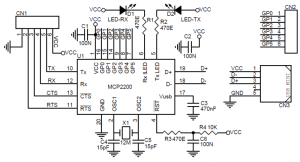
Specifications
- Supply 3- 5V DC
- On Board TX & RX LED
- USB activity LED outputs (TxLED and RxLED)
- Mini USB Interface
- 6 + 6 PIN Header Connector for I/O and RX-TX Signals
- UART signal polarity option General Purpose Input/output (GPIO) Pins
- Eight (8) general purpose I/O pins
- Supports Full-Speed USB (12 Mb/s)
- Implements USB Protocol Composite Device CDC Device (communications and control)
- Class 02h – CDC: USB-to-UART communications and I/O control
- Class 03h – HID: I/O control, EEPROM access, and initial configuration
- 128 byte buffer to handle data throughput at any UART baud rate
- 64 byte transmit
- 64 byte receive
- Fully configurable VID and PID assignments and string descriptors
- Bus Powered or self-powered USB Driver and Software Support
- Royalty-free drivers for Virtual Com Port (VCP)
- Windows XP (SP2 and later)/Vista/7
- Configuration utility for initial configuration
- Universal Asynchronous Receiver/Transmitter (UART)
- Support baud rates: 300 – 1000k (baud)
- Hardware flow control
- 256 bytes of user EEPROM
- SSPND output pin
- ULOAD output pin (indicates if requested current was allowed).
- Oscillator input: 12 MHz
For more detail: USB to UART Converter with GPIO – MCP220
- What is the primary function of the MCP2200 module?
The MCP2200 is a USB-to-UART serial converter that enables USB connectivity in applications with a UART interface. - How many general purpose input/output pins does the device have?
The device has eight general purpose I/O pins, four of which have alternate functions for status indication. - Does the MCP2200 include internal memory storage?
Yes, it includes 256 bytes of integrated user EEPROM. - What is the supported supply voltage range for this module?
The module requires a 3-5V DC supply. - What baud rate speeds are supported by the UART interface?
The device supports baud rates from 300 to 1000k. - Can the MCP2200 be used without an external host computer driver?
No, it requires royalty-free drivers for Virtual Com Port (VCP) or a configuration utility for initial setup. - What type of USB connector is used on the board?
The module features a Mini USB Interface. - Does the device support hardware flow control?
Yes, the specifications confirm that the device implements hardware flow control.