
Summary of USB LCD Controller
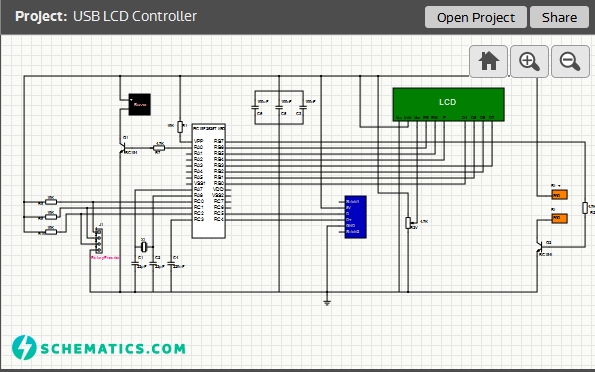
This project is a USB Generic HID device using a PIC18F2550 microcontroller to interface with an alphanumeric LCD. It features low-power nanoWatt technology, three serial ports (FS-USB, I2C, SPI, EUSART), and ample RAM/FLASH for data upload or firmware updates. The simple hardware design supports PCB, stripboard, or breadboard assembly, connecting the display via single-strand wires with an adjustable contrast potentiometer mounted underneath.
Parts used in the USB LCD Controller:
- PIC18F2550 microcontroller
- 20Mhz resonator
- Alphanumeric LCD display
- Contrast control potentiometer
- PCB artwork or stripboard/breadboard
- Single strand wire
This project is a USB Generic Human Interface Device (HID) device based on a PIC microcontroller. It is a USB interface for alphanumeric LCD display where the user as desired can program it. USB interface is implemented by using PIC18F2550 microcontroller ideal for low power (nanoWatt) and connectivity applications that benefit from the availability of three serial ports: FS-USB (12 Mbit/s), I2C and SPI (up to 10Mbit/s) and an asynchronous (LIN capable) serial port (EUSART).
 Large amounts of RAM memory for buffering and enhanced FLASH program memory make it ideal for embedded control and monitoring applications that require periodic connection with a (legacy free) personal computer via USB for data upload/download and/or firmware updates.
The hardware design is extremely simple. It can be build using the supplied PCB artwork or on a stripboard or breadboard. The circuit consists of a PIC18F2550 with a 20Mhz resonator and the required components for the LCD screen and the USB. The display is connected to the controller board using single strand wire. In addition, the contrast control potentiometer is placed underneath the board to allow easy adjustment after the LCD screen has been mounted.
For more detail: USB LCD Controller
- What type of device is this project?
This project is a USB Generic Human Interface Device based on a PIC microcontroller. - Which microcontroller is ideal for this application?
The PIC18F2550 microcontroller is used because it is ideal for low power and connectivity applications. - How many serial ports does the controller have?
The controller offers three serial ports including FS-USB, I2C, SPI, and an asynchronous serial port. - Can the firmware be updated via USB?
Yes, the device allows for periodic connection with a personal computer for firmware updates. - What are the options for building the hardware?
The circuit can be built using supplied PCB artwork, a stripboard, or a breadboard. - How is the display connected to the controller board?
The display is connected to the controller board using single strand wire. - Where is the contrast control potentiometer placed?
The contrast control potentiometer is placed underneath the board to allow easy adjustment.