


Summary of TDA7000 FM Receiver / TV Tuner / Aircraft Receiver using pic microcontoller
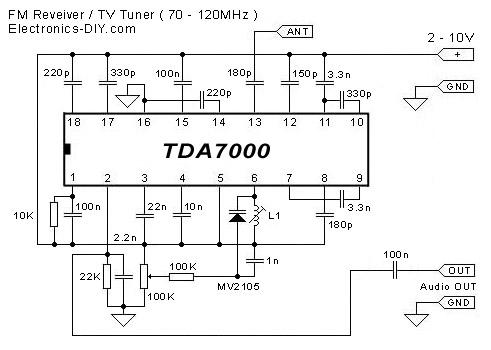
This article details the construction of a TDA7000 FM Receiver, an integrated circuit that simplifies RF design by combining oscillators, mixers, and demodulators into one chip. It requires minimal external components, making it ideal for beginners. The project operates between 70-120MHz with a low power consumption of 8mA, featuring an automatic muting circuit to eliminate spurious signals and ensure clear audio output.Parts used in the TDA7000 FM Receiver:
- TDA7000 IC
- 3.5 Turns Variable Coil (L1)
- MV2105 Varicap Diode
- Telescopic Antenna or wire
- 100K Potentiometer
- 100K Resistor
- 22K Resistor
- 100nF Capacitor
- 22nF Capacitor
- 10nF Capacitor
- 3.3nF Capacitor
- 2.2nF Capacitor
- 1nF Capacitor
- 330pF Capacitor
- 220pF Capacitor
- 180pF Capacitor
- 150pF Capacitor
|
|
 About TDA7000 FM Receiver / TV Tuner
TDA7000 is a great chip because it includes RF input stage, mixer, local oscillator, IF (intermediate frequency) Limiter, IF filter, amplifier, Phase demodulator, Mute detector, Frequency-Locked-Loop system and voltage controlled oscillator (VCO) all in a single chip, so you don't have to do so much tuning and tweaking as you would normally do in super heterodyne receivers. TDA7000 is also a great choice for folks that don't have great experience with RF circuits due to the fact that there are few external capacitors & resistors needed, no external IF filters, and only one variable coil and varicap diode.
The IC has an FLL (Frequency-Locked-Loop) system with an intermediate frequency of 70 kHz. The IF selectivity is obtained by active RC filters. The only function which needs alignment is the resonant circuit for the oscillator, thus selecting the reception frequency.
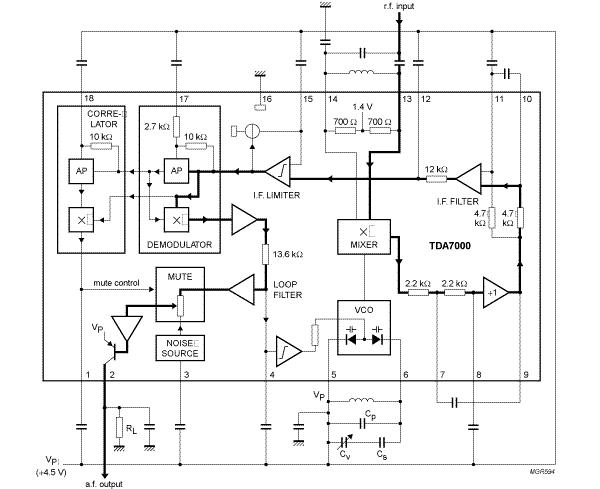 Spurious reception is avoided by means of using a muting circuit similar to squelch. This eliminates and rejects other input signals around selected frequency so that even remote stations can sound clear just as if they were located near by.
For more detail: TDA7000 FM Receiver / TV Tuner / Aircraft Receiver
Quick Solutions to Questions related to TDA7000 FM Receiver:
- What is the primary advantage of using the TDA7000 IC?
The TDA7000 integrates multiple functions like the mixer, oscillator, and demodulator into a single chip, reducing the need for extensive tuning. - How does the receiver handle spurious reception?
It uses a muting circuit similar to squelch to reject other input signals around the selected frequency. - What is the transmission frequency range of this project?
The transmission frequency ranges from 70 to 120MHz. - Can beginners build this circuit easily?
Yes, it is a great choice for those without RF experience because it needs few external components. - What voltage supply is required for operation?
The circuit requires a supply voltage between 2 and 10V. - Does the TDA7000 require external IF filters?
No, the IC does not require external IF filters as it uses active RC filters for selectivity. - What is the intermediate frequency used by the FLL system?
The Frequency-Locked-Loop system uses an intermediate frequency of 70 kHz. - How much power does the receiver consume?
The power consumption is 8mA.
Related projects
CAN FD Node based on a PIC18 Microcontroller
The introduction sets the stage for an embedded systems project that involves developing a Embedded C CAN FD project using the MCP2517FD...
Communication & InterfacingLAN9662 Gigabit Switch: Optimized for Industrial Ethernet
Introduction It should come as little surprise therefore that one element of what is now more commonly referred to in some circles...
Communication & InterfacingPIC Microcontroller: Fundamentals & Applications for Students
Introduction Microcontrollers are the key components in the embedded systems market. A variety of embedded systems was formed and developed after the...
Communication & Interfacing10BASE-T1S Ethernet: Simplified OEM Design for Auto Devices
Introduction Cars these days are surrounded by technology. They come loaded with all sorts of electronic gadgets and sensors. This project wants...
Communication & InterfacingDesigning a Microcontroller Framework for PC-Based Control of Electrical Appliances
ABSTRACT The preference for personal computers as a platform for designing and implementing control algorithms is growing due to the ease of...
Communication & InterfacingEfficient Multichannel Data Acquisition with USB Connectivity using PIC Microcontroller
1. INTRODUCTION With the rapid advancements in embedded technology, there is a growing demand for a data acquisition system that combines fast...

Ibrar Ayyub
I am an experienced technical writer holding a Master's degree in computer science from BZU Multan, Pakistan University. With a background spanning various industries, particularly in home automation and engineering, I have honed my skills in crafting clear and concise content. Proficient in leveraging infographics and diagrams, I strive to simplify complex concepts for readers. My strength lies in thorough...