
Summary of LT3950 – 60V, 1.5A LED DRIVER WITH INTERNAL EXPONENTIAL SCALE DIMMING
The LT3950 is a multi-topology DC/DC LED driver with a 1.5 A, 60 V DMOS switch that provides up to 20,000:1 dimming using an internal exponential-scale PWM generator and supports analog input dimming. It offers constant-current and output-voltage regulation, programmable switching frequency with spread spectrum and sync capability, and LED current set by a single sense resistor. The DC2788A demo board uses the LT3950 in a boost topology to drive 330 mA LED strings (up to 28 V as assembled, 60 V max), runs from 6–24 V, operates at 2 MHz, and includes UVLO and SSFM options.
Parts used in the LT3950 Boost LED Driver (DC2788A):
- LT3950 LED driver IC
- External PWM dimming PMOS
- Single external sense resistor
- Input supply (6 V to 24 V range)
- LED string (up to 28 V as assembled, 60 V max capability)
- Passive components for boost topology (inductor, input/output capacitors)
- Switching elements and layout supporting 2 MHz operation
- SYNC/SPRD pin connection for external clock
- Components for UVLO (set to 6.6 V with 1.0 V hysteresis)
High contrast applications (day to night) require high dimming ratios, and ADI’s LT3950 provides up to 20,000:1 dimming ratio, providing high dynamic range dimming for day/night vision. The flexibility to combine with analog input dimming provides accurate LED brightness control and eliminates the need for a microcontroller.
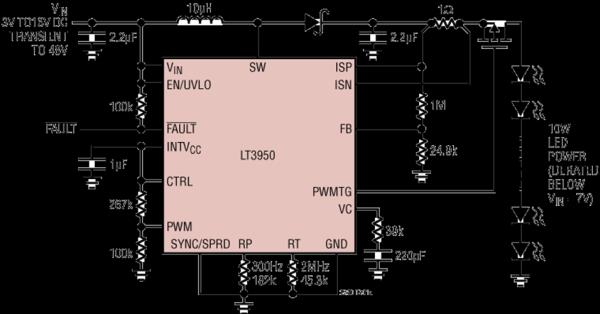
The LT3950 is a multi-topology DC/DC converter designed specifically to drive high current LEDs. It contains a 1.5 A, 60 V DMOS switch and supports an external PWM dimming PMOS. The LT3950 has an internal PWM generator for dimming that maps an analog control signal to an exponential scale used to define PWM dimming duty ratio. Using an exponential scale to define duty ratio preserves dimming resolution across a wide range of LED current. In addition to operating as a constant current source, the LT3950 also provides output voltage regulation. This can be used to prevent damage to the part in case of open LED events. A programmable switching frequency offers flexibility in design for higher efficiency or reduced component size. Enabling spread spectrum frequency modulation reduces EMI. The switching frequency can also easily be synchronized by driving the SYNC/SPRD pin with an external clock. LED current is programmed with a single external sense resistor and can be adjusted from zero to full-scale by an analog signal at the CTRL pin.
DC2788A is a boost LED driver featuring the LT3950. This demonstration circuit powers a string of LEDs at 330 mA. The step-up topology can be used to drive a string of up to 28 V of LEDs as assembled. The maximum output voltage capability of the LT3950 is 60 V. DC2788A runs from an input voltage range of 6 V to 24 V as built. It also runs at 2 MHz and has the capability to turn on spread spectrum frequency modulation (SSFM) for a frequency range of 2.0 MHz to 2.5 MHz. Dimming control can be achieved with analog dimming or PWM dimming either from an external or an internally generated clock source. DC2788A features undervoltage lockout (UVLO) set at 6.6 V with a 1.0 V hysteresis for turn-on.
Read more: LT3950 – 60V, 1.5A LED DRIVER WITH INTERNAL EXPONENTIAL SCALE DIMMING
- What dimming ratio does the LT3950 provide?
The LT3950 provides up to 20,000:1 dimming ratio. - Can the LT3950 use analog dimming without a microcontroller?
Yes. The LT3950 can combine analog input dimming with its internal PWM generator to eliminate the need for a microcontroller. - What is the maximum switch current and voltage of the LT3950?
The LT3950 contains a 1.5 A, 60 V DMOS switch. - How is LED current programmed on the LT3950?
LED current is programmed with a single external sense resistor and adjusted by an analog signal at the CTRL pin. - What input voltage range does the DC2788A demo circuit support as built?
DC2788A runs from an input voltage range of 6 V to 24 V as built. - What LED current and output voltage does DC2788A demonstrate?
DC2788A powers a string of LEDs at 330 mA and can drive up to 28 V of LEDs as assembled, with the LT3950 capable of up to 60 V. - Can the switching frequency be synchronized or modulated on the LT3950?
Yes. The switching frequency is programmable, can enable spread spectrum frequency modulation, and can be synchronized by driving the SYNC/SPRD pin with an external clock. - Does the LT3950 provide output voltage regulation?
Yes. In addition to constant current operation, the LT3950 provides output voltage regulation to protect against open LED events. - What switching frequency does DC2788A run at and what SSFM range is available?
DC2788A runs at 2 MHz and can enable SSFM for a frequency range of 2.0 MHz to 2.5 MHz.