
Summary of Interfacing 7-segment display with PIC12F1822 using CCS PIC C compiler
This article details a 3-digit digital counter project using a PIC12F1822 microcontroller and a 74HC164 shift register. The design employs multiplexing to drive three common anode 7-segment displays while minimizing pin usage. An internal 8MHz oscillator powers the system, and a push button on RA3 increments the count from 0 to 999. The implementation utilizes CCS PIC C compiler code to manage data shifting and display timing.
Parts used in the 3-Digit Digital Counter:
- PIC12F1822 microcontroller
- 74HC164N shift register
- Common anode 7-segment display
- Push button
- CCS PIC C compiler
The easiest way to interface 7-segment display with PIC12F1822 microcontroller is to add a serial-in parallel-out shift register. The adding of the shift register minimizes the number of pins used by the 7-segment display. This topic shows how to make a 3-digit digital counter with multiplexing and 74HC164 shift register using PIC16F877A and CCS PIC C compiler.
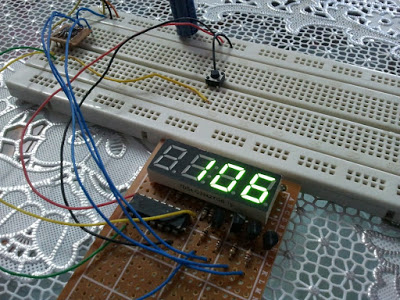
Interfacing PIC12F1822 with 7-segment display circuit:
Here is an example shows how to make a digital up counter where the number is displayed on a 7 segment display uses multiplexing technique with shift register.
Example circuit schematic is shown below where a common anode 7-segment display and 74HC164N shift register are used.
Other shift registers such as 74HC595 or CD4094 can be used in this project.
The displayed number can be incremented using the button which is connected to RA3 pin.
Here is an example shows how to make a digital up counter where the number is displayed on a 7 segment display uses multiplexing technique with shift register.
Example circuit schematic is shown below where a common anode 7-segment display and 74HC164N shift register are used.
Other shift registers such as 74HC595 or CD4094 can be used in this project.
The displayed number can be incremented using the button which is connected to RA3 pin.
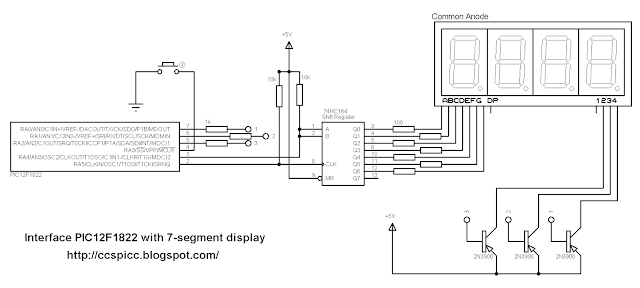
Internal oscillator of the microcontroller is used @ 8MHz and MCLR pin function is disabled.
The push button is connected to RA3 pin. The shift register used is 74HC164 but other types can work properly like 74HC595 or CD4094.
In this example all pins of PIC12F1822 are used and there is no free pin.
Interfacing PIC12F1822 with 7-segment display CCS C code:
// Interfacing PIC12F1822 with 7-segment display
// Common anode 7-segment display used
// http://ccspicc.blogspot.com/
// [email protected]

#include <12F1822.h>
#fuses NOMCLR INTRC_IO
#use delay(clock=8000000)
#use fast_io (a)


short s;   // Used to know button position
unsigned int j, digit, digit1, digit10, digit100;
unsigned long i = 0;
unsigned int seg(unsigned int num) {
  switch (num) {
    case 0 : return 0xC0;
    case 1 : return 0xF9;
    case 2 : return 0xA4;
    case 3 : return 0xB0;
    case 4 : return 0x99;
    case 5 : return 0x92;
    case 6 : return 0x82;
    case 7 : return 0xF8;
    case 8 : return 0x80;
    case 9 : return 0x90;
   }
}
void main() {
  setup_oscillator(OSC_8MHZ);          // Set internal oscillator to 8MHz
  set_tris_a(8);                       // Configure RA3 pin as input
  port_a_pullups(8);                   // Enable RA3 internal pull-up
  while(TRUE) {
   if(input(PIN_A3) == 1)
     s = 1;
   if(s == 1) {
     if(input(PIN_A3) == 0) {
       s = 0;
       i++;
       if(i > 999)
         i = 0;
     }
   }
   digit = i % 10;
   digit1 = seg(digit);
   output_a(7);                            // Turn off all displays
   for(j = 0x40; j > 0; j = j >> 1) {
     if(digit1 & j)
       output_high(PIN_A4);
     else
       output_low(PIN_A4);
     delay_us(10);
     output_high(PIN_A5);
     delay_us(10);
     output_low(PIN_A5);}
   output_low(PIN_A0);                     // Turn on display for ones
   delay_ms(1);
   digit = (i / 10) % 10;
   digit10 = seg(digit);
   output_a(7);                            // Turn off all displays
   for(j = 0x40; j > 0; j = j >> 1) {
     if((digit10 & j) != 0)
       output_high(PIN_A4);
     else
       output_low(PIN_A4);
     delay_us(10);
     output_high(PIN_A5);
     delay_us(10);
     output_low(PIN_A5);}
   output_low(PIN_A1);                     // Turn on display for tens
   delay_ms(1);
   digit = (i / 100) % 10;
   digit100 = seg(digit);
   output_a(7);                            // Turn off all displays
   for(j = 0x40; j > 0; j = j >> 1) {
     if((digit100 & j) != 0)
       output_high(PIN_A4);
     else
       output_low(PIN_A4);
     delay_us(10);
     output_high(PIN_A5);
     delay_us(10);
     output_low(PIN_A5);}
   output_low(PIN_A2);                     // Turn on display for hundreds
   delay_ms(1);
   }
}
Interfacing PIC12F1822 with 7-segment display video:
The following video shows project in a hardware circuit with some details.
- How can I interface a 7-segment display with a PIC microcontroller?
Add a serial-in parallel-out shift register like the 74HC164 to minimize pin usage. - What type of 7-segment display is used in this circuit?
A common anode 7-segment display is used. - Which microcontroller is utilized for the 3-digit counter?
The PIC12F1822 microcontroller is used. - Can other shift registers be used instead of the 74HC164?
Yes, types like 74HC595 or CD4094 can work properly. - How is the displayed number incremented?
The number is incremented by pressing a button connected to the RA3 pin. - What oscillator frequency is configured in the code?
The internal oscillator is set to 8MHz. - Does the MCLR pin function remain active in this setup?
No, the MCLR pin function is disabled. - What compiler is recommended for this project?
The CCS PIC C compiler is used.
