


Summary of GPS CIRCUIT BOATS COMPUTER PIC18F4550 MICROCONTROLLER
The GPS Boat Computer project utilizes a PIC18F4550 microcontroller and an EM 408 GPS module to display location, time, and compass data on a 2x16 LCD. The device features firmware reprogrammable via USB, allowing the same hardware to function as either a boat or car computer. Users can navigate multiple screens using UP/DOWN buttons and configure settings like time zones with a SET button.Parts used in the GPS Boat Computer:
- PIC18F4550 Microcontroller
- EM 408 GPS Module
- 2x16 LCD Display
- USB Connection Interface
- UP Button
- DOWN Button
- SET Button
- GPS Car Computer Kit (Optional for building)
EM408 PIC18F4550 GPS Boat Computer for Marine Navigation
The EM408 PIC18F4550 GPS Boat Computer is a marine electronics project designed to provide useful navigation and trip information on a compact 2×16 LCD. It combines a PIC18F4550 microcontroller with an EM408 GPS module and can display speed, heading, position, time, fuel information, and saved locations.
GPS Navigation and Boat Information
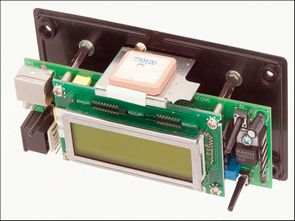
The EM408 GPS module receives satellite navigation data and sends position and movement information to the PIC18F4550 through a serial connection.
The system can display:
- Speed in knots
- Compass heading
- Latitude and longitude
- Date and time
- Fuel consumption rate
- Total fuel consumed
- Compass direction
Reliable GPS reception requires the antenna to have a reasonably clear view of the sky. Metal structures, enclosed installations, or electrical interference may reduce signal quality.
Saving Fishing and Diving Locations
One of the most practical features of the EM408 PIC18F4550 GPS Boat Computer is its ability to store up to eight favorite locations.
These saved points can be used to help navigate back to fishing spots, diving areas, or other positions that may have no visible landmarks nearby.
Saved GPS coordinates should still be treated as navigation aids rather than a replacement for appropriate marine navigation equipment.
Simple Button-Based Controls
The interface uses UP, DOWN, and SET buttons to move between screens and adjust settings.
UP and DOWN cycle through the available information screens, while SET allows editable values such as the time zone to be changed. The system also remembers the last selected screen when switched off and returns to it when power is restored.
Fuel Consumption Monitoring
The boat computer can display both current fuel consumption and the total amount used.
This function requires a compatible signal from the boat's fuel sensor or flow-measurement system. Calibration is important because different sensors may generate different signals for the same amount of fuel flow.
Marine Installation Considerations
Before installing the circuit on a boat, the LCD, buttons, GPS serial connection, and power supply should be tested on the workbench.
Marine electrical systems can experience alternator noise and voltage spikes, so regulated power and suitable input protection are important. The electronics should also be housed in a protected enclosure to reduce exposure to moisture, salt, and corrosion.
PIC18F4550 Project Resources
The project includes compiled HEX firmware, although the original source code is not available.
Even without editable firmware, the circuit provides a useful reference for studying how a PIC18F4550, GPS receiver, LCD, controls, and external sensors can be combined in a marine information system.
Final Overview
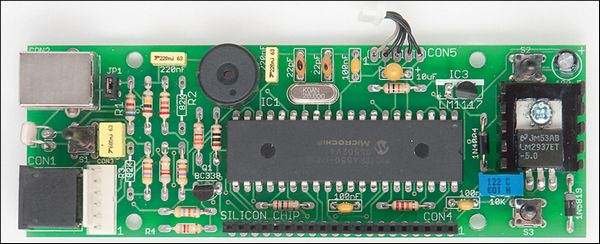
The EM408 PIC18F4550 GPS Boat Computer combines GPS navigation, waypoint storage, fuel monitoring, and basic marine trip information in a single microcontroller-based project.
Its most useful applications include displaying real-time navigation data and helping boat users return to previously saved locations while providing additional information about heading, speed, and fuel usage.
Source: GPS CIRCUIT BOATS COMPUTER PIC18F4550 MICROCONTROLLER Source 2: http://www.siliconchip.com.au/cms/A_112144/article.html Boats Computer GPS Circiut pcb, schematic, soruce code files Alternative link: gps-boats-computer-pic18f4550-microcontroller.raralternative link2 alternative link3
Quick Solutions to Questions related to GPS Boat Computer:
- How can I change the device from a car computer to a boat computer?
You can load the new firmware via USB from your computer without needing a PIC programmer. - Can I switch back to the car computer firmware later?
Yes, you can load the original Car Computer firmware via USB to flip back to that personality. - How long does it take to upload the new firmware?
Loading the new firmware takes only 20 seconds. - What buttons are used to select different information screens?
The UP and DOWN buttons allow you to select various screens showing useful information. - Does the device remember my last screen after turning off?
Yes, when power is reapplied, it automatically returns to the last screen viewed. - How do I configure settings like the time zone?
Press the SET button while on the desired screen, use UP/DOWN to adjust, and press SET again to save. - Do I need to build the circuit from scratch if I have a kit?
No, you can buy and build the GPS Car Computer kit and upload the new firmware to convert it. - Is the source code provided for this project?
No, the article states the source code is not included, but hex code and circuit design details are shared.
Related projects
PICDEM FS USB CDC Evaluation Board using PIC18F4550 with Proteus Simulation
Introduction The PICDEM FS USB CDC Evaluation Board is a practical microcontroller project built around the PIC18F4550, designed to demonstrate USB communication...
Peripheral Tutorials · PIC18F4550PICDEM FS USB Mass Storage Device using PIC18F4550 with Proteus Simulation
Introduction This microcontroller project demonstrates how to simulate a USB Mass Storage Device (MSD) using the PIC18F4550 in a Proteus simulation environment....
Development Boards & Kits · PIC18F2550Pinguino Project: A PIC Microcontroller Based Arduino
This is a complete tutorial to make a PIC Microcontroller based Arduino. This is a complete tutorial to make PIC microcontroller based...
Wireless & IoTExploring Various Applications of Microcontrollers: A World of Tiny Brains
Exploring Various Applications of Micro Controller Microcontrollers have become ubiquitous in the modern world with applications in nearly every industry. This student...
Wireless & IoTIntelligent Sips: Revolutionizing Dining with the SmartCup
Abstract The SmartCup Attachment is a comprehensive system designed for restaurants to monitor the liquid levels in their customers' cups. This system...
Wireless & IoTMaximizing Wi-Fi Capabilities with the Explorer 16 Development Board
As society progresses, the necessity for wireless communication is evolving from a mere luxury to an essential requirement. Wi-Fi, extending beyond conventional...

Ibrar Ayyub
I am an experienced technical writer holding a Master's degree in computer science from BZU Multan, Pakistan University. With a background spanning various industries, particularly in home automation and engineering, I have honed my skills in crafting clear and concise content. Proficient in leveraging infographics and diagrams, I strive to simplify complex concepts for readers. My strength lies in thorough...