Summary of Tiny Solar Energy Module (TSEM)
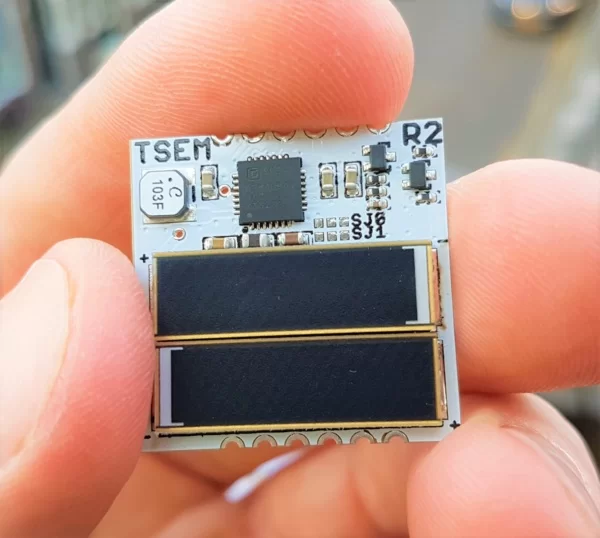
This 1x1 inch Tiny Solar Energy Module (TSEM) utilizes two mono-crystalline solar cells and an AEM10941 harvesting IC to power indoor BLE or LoRa sensors. It features ultra-low power startup at 380 mV, MPPT tracking every 5 seconds, and provides regulated 3.3V and 1.8V outputs. The board supports surface-mount installation via castellated vias or breadboard use with headers, storing energy in a compatible 110mAh LiPo battery for applications requiring under 23uA average current.
Parts used in the Tiny Solar Energy Module:
- Tiny Solar Energy Module PCB
- Two tiny mono-crystalline solar cells
- AEM10941 harvesting IC
- Li-Ion battery charger
- Regulated 3.3V output
- Regulated 1.8V output
- Castellated vias
- 0.1" headers
- 110mAh LiPo battery
- External solar panel (optional)
Description
Details
Ideal for indoor applications
The AEM10941 harvesting IC is very suitable for indoor applications because it has an ultra low power startup. The boost converter starts at a very low 380 mV input voltage and 3 uW input power. The IC gets most power out of the solar cells by doing MPPT maximum power point tracking every 5 seconds. In addition the mono crystaline solar cells have a very wide spectral range resulting in 22% efficiency. This makes TSEM very suitable for indoor applications.
How much energy does is harvest indoors?
Indoor light is about 1/100th of outdoor light or 10W/m2. At that power solar cell open voltage is 0.458V and I estimate Vmp at 0.36V per cell. Since we have two in series the booster will work at 0.72V input voltage. At that voltage boost efficiency is about 75% . LiPo charge efficiency is about 95%. Battery current is 5.72 times smaller than the solar current because the voltage increases from 0.72 V to 4.12 Volt. Finally I assume that indoor light is available for 10 hours a day. 44mA * 1/100th * 75% * 95% * 0.72V/4.12V * 10 hrs = 0.55 mAh is harvested every day. So an application must have an average current less than 0.55mAh/24h = 23uA, that’s enough for a simple Bluetooth Low Energy beacon or a very simple LoRa application. However if the device is in full sun for only one hour a day it harvests ~10x more: 7 mAh.
If you need to harvest more then you may connect an external solar panel to the castellated via’s. Below is a comparison between the on-board solar cells and external solar cells with respect to cost, dimensions, and the energy harvested per day.
| Solar panel | Harvested energy per day, indoors (mAh) | Application average current (uA) |
|---|---|---|
| 2x $1.02 On-board 0.5V/44mA 22x7mm Ixys KXOB22-12X1L | 0.55 | 23 |
| 1x $1.06 External 1V/100mA 30x25mm | 1.1 | 45 |
| 1x $1.31 External 2V/100mA 79x28mm | 2.9 | 120 |
| 1x $1.18 External 4V/100mA 70x70mm | 6.7 | 279 |
The harvested energy can be stored in this 110mAh 3*20*25mm LiPo battery. This battery fits very nice below the module.
Read more: Tiny Solar Energy Module (TSEM)
- How much energy does the module harvest indoors daily?
The module harvests approximately 0.55 mAh per day assuming indoor light is available for 10 hours. - What is the minimum input voltage required for the boost converter?
The boost converter starts operating at a very low input voltage of 380 mV. - How often does the IC perform maximum power point tracking?
The IC performs MPPT maximum power point tracking every 5 seconds. - Can I connect an external solar panel to increase power?
Yes, you can connect an external solar panel to the castellated vias if more energy harvesting is needed. - What is the average current limit for a simple Bluetooth Low Energy beacon using this module?
An application must have an average current less than 23uA to run continuously on harvested indoor energy. - What are the regulated output voltages provided by the board?
The board provides two regulated outputs: 3.3V and 1.8V. - How can the board be mounted on a circuit board?
The board has castellated vias allowing it to be surface mount soldered onto a mother PCB or soldered onto 0.1" headers for breadboards. - What type of battery fits below the module?
An 110mAh 3*20*25mm LiPo battery fits nicely below the module.