


Summary of PIC16F690 BQ2018 BATTERY MONITOR CIRCUIT
This article describes a battery monitoring system designed for lead-acid batteries, such as those in a solar-powered setup. The project utilizes a PIC16F690 microcontroller and a BQ2018 coulomb counter IC to track charge and discharge cycles. It features an LCD display showing voltage, capacity in Ampere-hours (Ah), and current usage percentages. Key objectives include a wide measuring range (up to 100A), high accuracy (0.1% linearity), low power consumption, and NMEA output compatibility for external monitoring systems.Parts used in the Battery Monitor Project:
- PIC16F690 microcontroller
- BQ2018 coulomb counter IC
- LCD display
- Shunt resistance
- Solar panel (25W NAPS)
- Lead acid battery (110Ah)
- Kylboxen compressor
Battery monitor PIC16F690 microcontroller based on the circuit current sensors on the floor BQ2018 enteree is used shunt resistance taken over by the value on the LCD display battery voltage, use percentage (battery, battery... Electronics Projects, PIC16F690 BQ2018 Battery Monitor Circuit "battery charger circuit, microchip projects, microcontroller projects, "
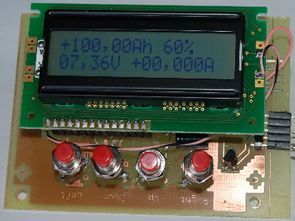
Battery monitor PIC16F690 microcontroller based on the circuit current sensors on the floor BQ2018 enteree is used shunt resistance taken over by the value on the LCD display battery voltage, use percentage (battery, battery Ah value), the current drawn displaying information. Current measuring range. One of the highest 999Ah capacity from 100 Amps
PIC16F690 BASED BATTERY MONITOR
This page describes a battery monitoring projects. When you sail so have time to think and a thought that popped up was: “Is the charge in our battery?”. s / y Moulin Rouge has a 110Ah lead acid battery which only charged via a solar panel 25W NAPS. The largest consumer is kylboxens compressor. Both the charge-discharge rate is not constant over time. Measured with a battery monitor takes the box below about 8.5 Ah / day.
Monitoring the charge of a lead acid battery is not an exact science. Most accurate results you get if you check the electrolyte specific gravity with a hydrometer, but it is rather cumbersome. In order to know which direction it is tilted so one can expect the current into the battery, and over time. Ideally, you lie on the plus and have a margin. One can also measure the battery resting tension corresponding to the charge rate at 20C.
If you build yourself so you can get it just like you want it. The objectives of my project were:
Wide measuring range. 1mA .. 10A, 100A or 10mA ..
Maximum 999Ah capacity
Must withstand transient loads
Reasonably low own consumption (compared to battery self discharge)
Dissolution greater than 1/1000
Linearity 0.1%
NMEA output for monitoring
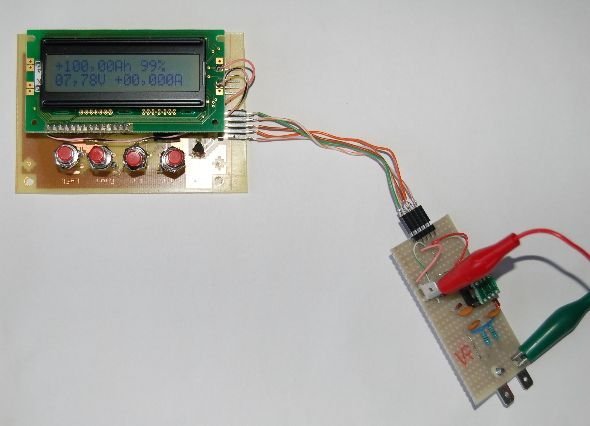
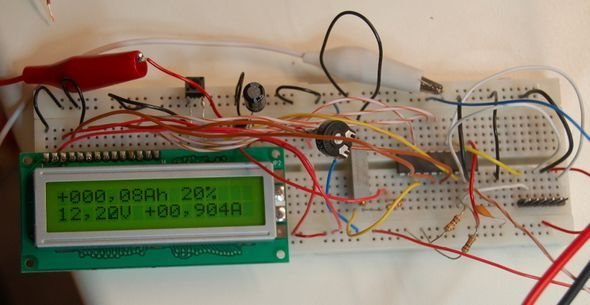

Source: PIC16F690 BQ2018 BATTERY MONITOR CIRCUIT alternative pic16f690-bq2018-battery-monitor-circuit
- What components are used to build this battery monitor?
The project uses a PIC16F690 microcontroller, a BQ2018 coulomb counter, an LCD display, and shunt resistance. - How is the battery capacity displayed on the device?
The LCD display shows battery voltage, percentage, and Ampere-hour (Ah) values. - What is the maximum current measuring range of this circuit?
The circuit supports a current measuring range up to 100 Amps. - Can this system handle transient loads?
Yes, one of the project objectives was to ensure it can withstand transient loads. - What level of linearity does the measurement achieve?
The system aims for a linearity of 0.1%. - Does the project support external monitoring interfaces?
Yes, the design includes NMEA output for monitoring purposes. - Why is measuring electrolyte specific gravity not the primary method here?
Checking specific gravity with a hydrometer is considered cumbersome compared to electronic monitoring. - What is the maximum capacity value the system can track?
The system is designed to measure a maximum capacity of 999Ah.
Related projects
Air Sampler using PIC16F690 microcontroller
Do you ever wonder what is in the air you breathe? Or maybe you have hay fever and want to know what...
LCD & Display Projects · PIC16F690LCD Module Control over IR Link using PIC16F690
Recently I got my hands on a couple of HSDL-1100 based IR transceivers and a KS070B LCD display module. This was a...
LED Projects · PIC16F6908×8 LED matrix using PIC16F690 microcontroller
8x8 LED matrix This instructable will show you how to make a 8x8 LED matrix in witch you can control evry single...
Power & BatteryImplementing Smart Cooling Control for Induction Heaters with PIC Microcontrollers
Today, induction heating powers countless industrial processes like melting, heat treatment, and welding, plus everyday appliances like cooktops. Its key advantages? High...
Power & BatteryIntegrating Solar Power: Microcontroller-Based Approaches for Domestic Electricity
Abstract: Microcontrollers have found extensive application in endeavors aimed at reducing power consumption. The availability of microcontroller development tools has made them...
Power & BatteryEfficient Power Generation with Microcontroller-Controlled Thermoelectric Generators
INTRODUCTION The global demand for electrical energy continues to rise steadily, necessitating a shift towards renewable energy sources as traditional fossil fuels...

Ibrar Ayyub
I am an experienced technical writer holding a Master's degree in computer science from BZU Multan, Pakistan University. With a background spanning various industries, particularly in home automation and engineering, I have honed my skills in crafting clear and concise content. Proficient in leveraging infographics and diagrams, I strive to simplify complex concepts for readers. My strength lies in thorough...