
Summary of Inside the vintage 74181 ALU chip: how it works and why it’s so strange
The 74181 ALU chip, introduced by Texas Instruments in March 1970, revolutionized minicomputer design by integrating a full 4-bit arithmetic and logic unit onto a single fast TTL chip. It offered 32 distinct functions and utilized carry lookahead for high-speed processing, replacing complex gate assemblies with a compact solution used in systems like the PDP-11 and VAX-11/780.
Parts used in the 74181 ALU Project:
- 74181 Arithmetic / Logic Unit chip
- TTL chip components
- Circuit diagram gates
- Full adder circuits (contextual comparison)
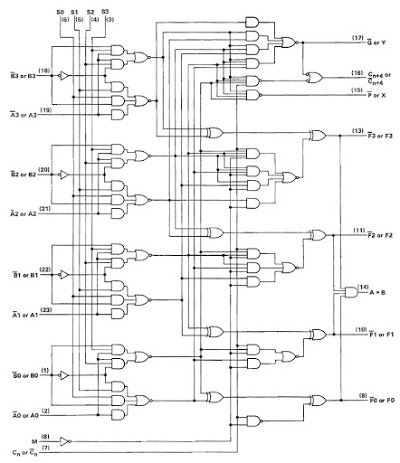
The 74181 ALU (arithmetic/logic unit) chip powered many of the minicomputers of the 1970s: it provided fast 4-bit arithmetic and logic functions, and could be combined to handle larger words, making it a key part of many CPUs. But if you look at the chip more closely, there are a few mysteries. It implements addition, subtraction, and the Boolean functions you’d expect, but why does it provide several bizarre functions such as “A plus (A and not B)”? And if you look at the circuit diagram (below), why does it look like a random pile of gates rather than being built from standard full adder circuits. In this article, I explain that the 74181’s set of functions isn’t arbitrary but has a logical explanation. And I show how the 74181 implements carry lookahead for high speed, resulting in its complex gate structure.
The 74181 chip is important because of its key role in minicomputer history. Before the microprocessor era, minicomputers built their processors from boards of individual chips. A key part of the processor was the arithmetic/logic unit (ALU), which performed arithmetic operations (addition, subtraction) and logical operations (AND, OR, XOR). Early minicomputers built ALUs out of a large number of simple gates. But in March 1970, Texas Instruments introduced the 74181 Arithmetic / Logic Unit (ALU) chip, which put a full 4-bit ALU on one fast TTL chip. This chip provided 32 arithmetic and logic functions, as well as carry lookahead for high performance. Using the 74181 chip simplified the design of a minicomputer processor and made it more compact, so it was used in many minicomputers. Computers using the 74181 ranged from the popular PDP-11 and Xerox Alto minicomputers to the powerful VAX-11/780 “superminicomputer“. The 74181 is still used today in retro hacker projects.1
for more detail: Inside the vintage 74181 ALU chip: how it works and why it’s so strange
- What year was the 74181 ALU chip introduced?
Texas Instruments introduced the 74181 chip in March 1970. - How many arithmetic and logic functions does the 74181 provide?
The chip provides 32 arithmetic and logic functions. - Why does the 74181 circuit look like a random pile of gates?
The complex structure results from its implementation of carry lookahead for high speed. - Which minicomputers used the 74181 chip?
It was used in the PDP-11, Xerox Alto, and VAX-11/780. - Can the 74181 handle larger words than 4 bits?
Yes, multiple chips can be combined to handle larger words. - Does the 74181 still have users today?
Yes, the chip is still used in retro hacker projects.