
Summary of High- Frequency Transistor Amplifier Calculator
Parts used in the High-Frequency Transistor Amplifier Calculator:
- Reference spreadsheet
- Common-Emitter amplifier circuit
- Common-Collector amplifier circuit
- Bipolar transistor
- LTSpice simulation package (for comparison)
Common-Emitter and Common-Collector Transistor Amplifier Calculator for High-frequency Operation
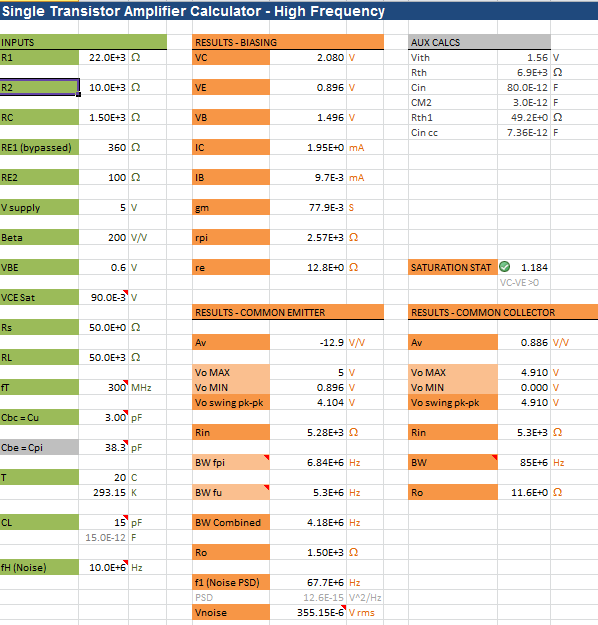
Analysis of the bipolar transistor amplifier at low-frequency is relatively easy, and several calculators exist online that do a good job. For high-frequency operation, there are fewer references available. For my projects, I like to build a reference spreadhseet where everything is in one place. This allows me more flexibility in optimizing the circuit, and is much faster than simulating with LTSpice or similar package. Furthermore, constructing such a tool is a great way of gaining more insight into how the circuit works, and how each of the parameters affects performance. The two amplifier circuits covered in this spreadsheet are depicted in Figure 1 and 2. Figure 1 is the Common-Emitter amplifier and is useful for relatively high gain applications with moderate input and output impedance. The Common Collector circuit in Figure 2, has a gain close to 1 and is useful as a buffer circuit with its low output impedance and moderate to high input impedance.
For more detail: High- Frequency Transistor Amplifier Calculator
-
Why is a reference spreadsheet preferred over LTSpice for this project?
A reference spreadsheet allows for more flexibility in optimizing the circuit and is much faster than simulating with LTSpice or similar packages. -
What are the two amplifier circuits covered in the calculator?
The calculator covers the Common-Emitter amplifier and the Common-Collector amplifier. -
What is the primary use case for the Common-Emitter amplifier?
The Common-Emitter amplifier is useful for relatively high gain applications with moderate input and output impedance. -
How does the Common-Collector circuit function as a buffer?
It functions as a buffer because it has a gain close to 1, low output impedance, and moderate to high input impedance. -
Why are there fewer references available for high-frequency operation compared to low-frequency?
Analysis of bipolar transistor amplifiers at low-frequency is relatively easy with many existing calculators, whereas high-frequency operation has fewer references available. -
How does building this tool help with understanding the circuit?
Constructing such a tool provides insight into how the circuit works and how each parameter affects performance. -
What is the main advantage of using a single spreadsheet for all parameters?
Having everything in one place allows for greater flexibility in optimizing the circuit.