


Summary of Grid Powered Battery Charger – The Plans using PIC16F676
This article describes a Grid Charger Voltage Switch designed for alternative energy systems. It uses a PIC microcontroller to monitor battery levels and automatically engage a grid-powered charger during generation shortfalls, preventing deep discharge. This allows users to maintain continuous appliance operation even when solar or wind power is unavailable.Parts used in the Grid Charger Voltage Switch:
- PIC 16F676 Microcontroller
- Solid State Relay
- Battery Array
- Charge Controller
- Grid Powered Battery Charger
You get a really good feeling when you plug in some lights and appliances and power them with your own electricity from the sun or wind. You get a really bad feeling when you run those items and the clouds come for days or weeks or months on end. The batteries get lower and lower. Capitulation comes when you have to unplug those appliances and hook them back up to the public utility power. This circuit lets you keep the appliances plugged into your inverter. It won't make the wind blow or the clouds go away, but it will keep your batteries safely charged even if you have a generation shortfall. I call it the Grid Charger Voltage Switch.
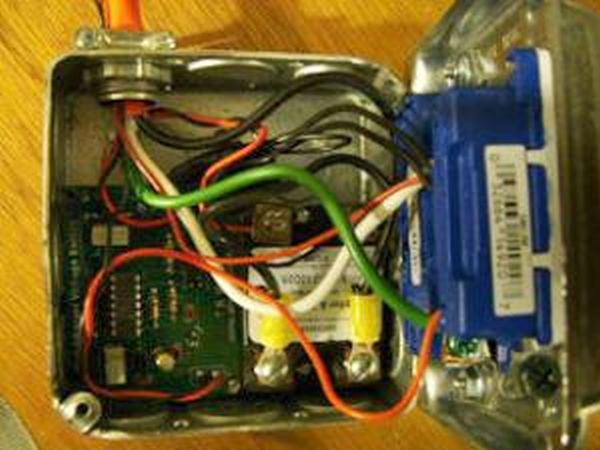
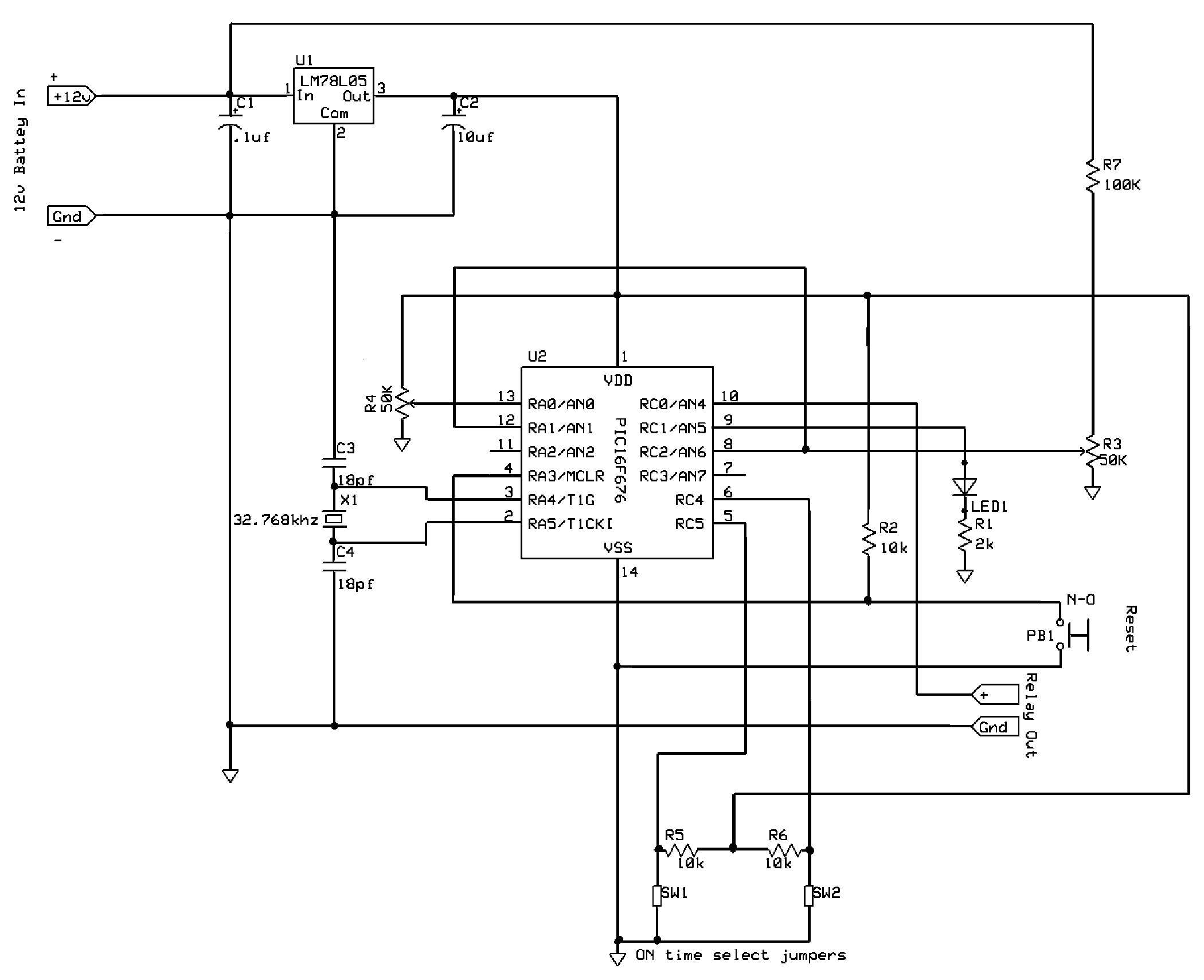
The circuit utilizes a PIC microcontroller to monitor battery voltage and control a solid state relay, turning it ON for a time period when battery voltage falls below an adjustable low voltage set point and OFF if it exceeds an adjustable high voltage set point.
PIC 16F676 Microcontroller Grid Charger Voltage Switch Schematic Diagram (click for larger)
The circuit is extremely useful in alternative energy applications such as wind or solar, which experience long periods of calm or clouds when no power is generated to feed the battery array. The switch works in tandem with your charge controller. You charge your batteries using your wind or solar generation capacity just like you always do, but if the batteries get low because your wind or solar stops, this device will automatically turn on a grid powered battery charger to protect the batteries from chronic undercharging.
It will permit you to run continual loads even when the sun doesn't shine or the wind doesn't blow.
For more detail: Grid Powered Battery Charger - The Plans using PIC16F676
Quick Solutions to Questions related to Grid Charger Voltage Switch:
- How does the circuit protect batteries?
The circuit monitors battery voltage and turns on a solid state relay to activate a grid charger when voltage falls below a set point. - Can this device work with solar or wind systems?
Yes, it is extremely useful in alternative energy applications like wind or solar that experience long periods of calm or clouds. - Does this device replace the existing charge controller?
No, the switch works in tandem with your existing charge controller while providing backup charging from the grid. - What happens if battery voltage exceeds the high set point?
The solid state relay turns OFF if the battery voltage exceeds the adjustable high voltage set point. - Can I run continual loads during bad weather?
Yes, the device permits you to run continual loads even when the sun does not shine or the wind does not blow. - What triggers the grid charger to turn on?
The grid charger turns on when the battery voltage falls below an adjustable low voltage set point. - Is the voltage threshold adjustable?
Yes, both the low voltage set point and the high voltage set point are adjustable. - What component controls the switching action?
A PIC microcontroller is utilized to monitor voltage and control the solid state relay.
Related projects
30 volts Panel Volt Meter Using PIC MCU
This is a simple application of internal 10-bit ADC(analog to digital converter) of PIC16F676 microcontroller.you can use this circuit to measure up...
Audio, Sound & Radio · PIC16F676Shrieker using PIC16F676 Microcontroller
Recently a cell phone ring tone was in the news - it's 17,000 Hertz and meant to be heard by teenagers, but...
Sensors & Temperature · PIC16F676Temperature Indicator using PIC microcontroller
Hi friends, today we will see how to make temperature indicator using PIC microcontroller. The basic aim of this project is make...
Power & BatteryImplementing Smart Cooling Control for Induction Heaters with PIC Microcontrollers
Today, induction heating powers countless industrial processes like melting, heat treatment, and welding, plus everyday appliances like cooktops. Its key advantages? High...
Power & BatteryIntegrating Solar Power: Microcontroller-Based Approaches for Domestic Electricity
Abstract: Microcontrollers have found extensive application in endeavors aimed at reducing power consumption. The availability of microcontroller development tools has made them...
Power & BatteryEfficient Power Generation with Microcontroller-Controlled Thermoelectric Generators
INTRODUCTION The global demand for electrical energy continues to rise steadily, necessitating a shift towards renewable energy sources as traditional fossil fuels...

Ibrar Ayyub
I am an experienced technical writer holding a Master's degree in computer science from BZU Multan, Pakistan University. With a background spanning various industries, particularly in home automation and engineering, I have honed my skills in crafting clear and concise content. Proficient in leveraging infographics and diagrams, I strive to simplify complex concepts for readers. My strength lies in thorough...