
Summary of Analog & Digital propeller clock using PIC16C84
This article describes an analog and digital propeller clock built by Luberth Dijkman in 1997, based on Don Zehnder's design and utilizing the afterimage phenomenon. The project uses a PIC16C84 microcontroller running at 10 MHz to control LEDs mounted on a Mecano base. It features a motor from a Philips VCR, an infrared gate for rotation pulses, and a reed switch for time setting. The build includes diffused red and green LEDs arranged in inner and outer rings, with specific driver configurations involving transistors.
Parts used in the Analog & Digital Propeller Clock:
- 14 red diffused LEDs (Kingbright L-53-SRD-D)
- 1 Green LED
- PIC16C84 microcontroller
- Mecano metal construction base
- Philips VCR VR 2022 motor
- Infrared gate sensor
- Reed switch
- Transistor
- Brush/slipring assembly
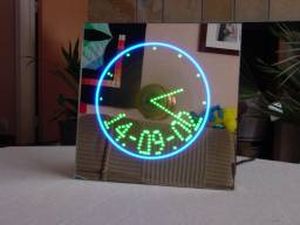
An Analog & Digital propeller clock i made!
It isnt Real its just because your so awfully slow!!! 😉
Picture’s made 12-12-1997 by Luberth Dijkman Clock was actually running 2 weeks earlyer
Bob Blick started the propeller clock
This clock is based on Don Zehnder’s Clock. He made the first analog version (+/- 1996)
Some technical information!
Assembler Code written by Don Zehnder
This clock has 14 red led’s & 1 Green
(red diffused 200 to 300 Mcd Kingbright L-53-SRD-D)
I prefer difused LEDs as they are better vissible from the side(angle)
Bright LEDs are perfect only when you look/stand straight in front of it
Tommorow (13-12-’97)i wil try red diffused 700 to 1000 Mcd Kingbright L-53-SRD-G
Nowadays(2002)a large choice, back in 1997 it was a bit harder to get ultra bright led’s
The propeller is mounted on a “Mecano”(Kid’s metal construction) base
7 outher led’s are controlled direct from pic’s port
8 inner led’s are together switched by a transistor
The moter comes out a Philips VCR VR 2022 two of them in 1 recorder
A 4mhz pic16c84 is clocked at 10 mhz
Later i made a brush/slipring the balbearing give too much errors
Rotation pulse is given by infrared gate
Time setting is done with a reed switch (when a magnet apears near propellor time speeds up)
Luberth Dijkman Andijk Holland 12-12-1997
For more detail: Analog & Digital propeller clock using PIC16C84
- How does the illusion of reality work in this clock?
The illusion is based on the afterimage phenomenon caused by the reaction slowness of the retina. - What microcontroller is used in the project?
A 4mhz pic16c84 is used, which is clocked at 10 mhz. - Why are diffused LEDs preferred over bright ones?
Difused LEDs are better visible from the side angle, whereas bright LEDs are perfect only when looking straight in front. - How is the rotation pulse detected?
Rotation pulse is given by an infrared gate. - What mechanism is used for time setting?
Time setting is done with a reed switch that speeds up the time when a magnet appears near the propellor. - Where did the motor come from?
The motor comes out of a Philips VCR VR 2022. - How many LEDs are controlled directly from the PIC port?
7 outher led's are controlled direct from pic's port. - Why was a brush/slipring made instead of using ball bearings?
The balbearing give too much errors.
