


Summary of Almost No Parts’ 12/24hrs LED Clock using pic microcontroller
This article describes the "ANP LED Clock," a compact project using a PIC 16F84A or 16F628A microcontroller. It features 12/24-hour display options, brightness control, and battery operation with only ten parts. The design uses charlieplexing to minimize I/O ports and supports both common anode and cathode displays.Parts used in the ANP LED Clock:
- 1 PIC 16F84A microcontroller
- 2 22pF Capacitors
- 2 n.o. switches
- 1 4Mhz Xtal oscillator
- 4 CA or CC 7-segment LED displays
A 12hr/24hr LED Clock with display control, uses a microcontroller PIC 16F84A or 16F628A and a few parts. (August 25, 2009)
This LED clock may not be the easiest to build but surely it is the one with fewer parts that you can find, for that reason I call it "The ANP LED Clock". (ANP stands for Almost No Parts.)
Using the micro controller PIC 16F84A or the 16F628 (same pinout), this clock have more and improved features than my previous LED Clock.
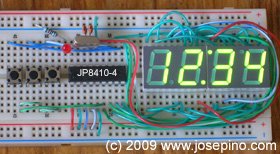 Here are the features on this ANP LED Clock
- Can use common cathode or common anode 7-segment LED displays.
- Displays time as 12 hours or 24 hours format.
- Allows to enable or disable the display for battery-operated circuits.
- Can control the display brightness to reduce power consumption
- 7-segment LED displays are charlieplexed to reduce I/O ports usage.
- PM LED indicator (optional)
- Only 10 parts needed: 1 PIC 16F84A, 2 22pF Capacitors, 2 n.o. switches, 1 4Mhz Xtal and 4 CA or CC 7segment LED displays.
- Operates from 2.5 to 5.5 Volts, it can even work with a 3V coin batteryBecause all this features, the applications for this ANP LED Clock could be:
- Inexpensive LED Clock to replace the expensive broken one from your luxury car.
- "vintage" LED wristwatch - Using some LED display from old calculators and 3 Volts coin battery, it's possible to build a small clock.
- Jumbo Clock - Non-inverting buffers can be used to drive more voltage and lit giant 7-segment led displays.
- Compact clock for your appliances or projects
Even more:
- Desktop Clock as gift for a friend
- Nice clock to keep your 4-years old niece distracted for a while
- A piece of trash after your 4-years old niece were playing with the clock.
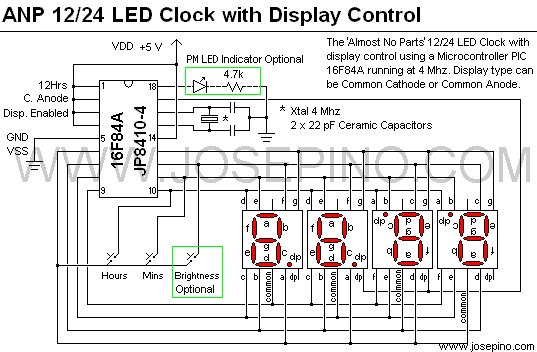 Pin 1 to VDD for 12Hrs, VSS for 24Hrs
Pin 2 to VDD C Anode display, VSS for C Cathode
Pin 3 to VDD Enable display, VSS disable display
Pin 4 to VDD Normal operation, VSS Reset
Pin 5 VSS Ground or -
Pins 6..13 To multiplexed display
Pin 14 VDD or +
Pins 15 & 16 Xtal Oscillator (4Mhz only)
Pin 17 to Display Decimal Point
Pin 18 PM LED indicator (optional)
For more detail: Almost No Parts' 12/24hrs LED Clock
Quick Solutions to Questions related to ANP LED Clock:
- What microcontrollers can be used for this clock?
The clock uses a PIC 16F84A or the 16F628A which share the same pinout. - Can the display format be changed between 12 and 24 hours?
Yes, connecting Pin 1 to VDD sets 12-hour mode while VSS sets 24-hour mode. - Does the clock support both common anode and common cathode displays?
Yes, you can configure it for either type by setting Pin 2 to VDD for common anode or VSS for common cathode. - How does the clock reduce power consumption?
It allows users to enable or disable the display and control the brightness to save power. - What is the operating voltage range for this circuit?
The clock operates from 2.5 to 5.5 Volts and can work with a 3V coin battery. - How many parts are required to build this project?
Only 10 parts are needed including the microcontroller, capacitors, switches, crystal, and displays. - Is there an option for a PM indicator?
Yes, Pin 18 serves as an optional PM LED indicator. - What happens if Pin 4 is connected to VSS?
Connecting Pin 4 to VSS puts the device into Reset mode instead of normal operation.
Related projects
PIC Stepper Motor Controller using PIC16F84A with Proteus Simulation
Introduction Stepper motors are widely used in embedded systems and DIY electronics projects where precise position control is required. This PIC Stepper...
Programmers & ICSP · PIC16F84APIC Musical Doorbell using PIC16F84A with Proteus Simulation
IntroductionThis microcontroller project demonstrates a musical doorbell built around a PIC16F84A and a simple piezo sounder.Using two push buttons, the system allows...
Beginner Tutorials · PIC16C84Exploring the World of PIC Microcontrollers: An Architectural Overview
A Peripheral Interface Microcontroller (PIC), developed by General Instruments Microcontrollers in 1993, operates under software control and is programmed to execute various...
Clocks & TimersAdaptive Alarm Clock: Build a Smart, User-Centric wake-Up system
Project Overview The goal of this ambitious undergraduate project was to develop a novel alarm clock capable of analyzing a person's unique...
Clocks & TimersDesigning Your Ideal Alarm Clock: An Introduction to PIC18
Within this laboratory session, you'll employ the C language to create an alarm clock, delving into the implementation of "C" programs on...
Clocks & TimersBuilding your Dream Alarm Clock Using the PIC18
Objective: In this laboratory session, your objective is to create an alarm clock using the C programming language. You will gain proficiency...

Ibrar Ayyub
I am an experienced technical writer holding a Master's degree in computer science from BZU Multan, Pakistan University. With a background spanning various industries, particularly in home automation and engineering, I have honed my skills in crafting clear and concise content. Proficient in leveraging infographics and diagrams, I strive to simplify complex concepts for readers. My strength lies in thorough...