
Summary of Post Project 61: KaraOkay Microphone Amplifier
This article describes an all-analog, through-hole microphone preamplifier with adjustable gain, using a TLC272 dual op amp for low noise. One op amp stage buffers and amplifies an electret microphone with selectable gain via switch S1 and resistor network R4–R8, providing three gain settings (≈47 dB, 23 dB, 35 dB). The design includes microphone biasing, coupling capacitors, USB power, and loudspeaker output for karaoke and similar applications.
Parts used in the KaraOkay Microphone Amplifier:
- TLC272 dual operational amplifier (IC1 with IC1a and IC1b)
- Electret microphone
- C1 coupling capacitor
- R3 microphone bias resistor
- R4 resistor (part of gain network)
- R5 resistor (switchable gain resistor)
- R6 resistor (switchable gain resistor)
- R7 resistor (part of gain network)
- R8 feedback resistor
- S1 three-position gain selector switch
- USB power supply connection
- Loudspeaker output stage / connector
With adjustable tone control, USB power and loudspeaker output
By Elektor Labs India
Here is an all-analog, all-through-hole, cheap & cheerful preamplifier for that perennial problem of getting the microphone amplification just right, which is a challenge not only with the faithful reproduction of lead vocals during concerts and recordings, but also with campfire and karaoke-ish performances specially when the beer takes hold.
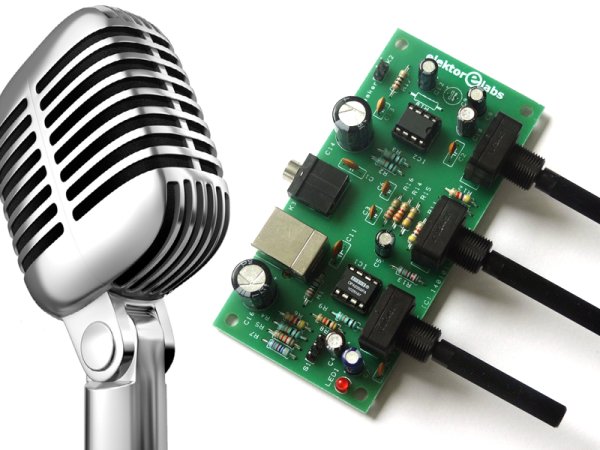
The two operational amplifiers of the circuit, IC1a and IC1b are contained in s single TLC272 package. The TLC272 was selected mainly for its low noise contribution, which is essential in a microphone (pre)amplifier as the original signal from the microphone is relatively weak (except for Matt Bellamy on his Muse concerts). IC1a operates as a non-inverting amplifier with the electret microphone signal applied to pin 3 via coupling capacitor C1, and the bias voltage applied to the microphone element via R3. IC1a’s amplification factor A is determined by the ratio of R8 to one of three combinations allowed by R4–R7. Let’s call that resistance, Req. At switch position ‘1’ i.e. with R5 switched into the circuit by S1, the factor will be:
Req = R4 || R5 || R7 = 449 Ω
A(1) = (1 + R8 / Req) = 223.7 ≡ 47 dB
Likewise with S1 at its center position a factor A(2) of about 14 (23 dB) is selected, and finally with R6 switched-in (S1 position 3) A(3) works out as 60 (35 dB). With selector S1 offering different gains, the circuit can be matched to different input levels, microphones, vocalists, and beer levels.
For more detail:Post Project 61: KaraOkay Microphone Amplifier
- What op amp does the project use?
The project uses a TLC272 dual operational amplifier (IC1 containing IC1a and IC1b). - How is the microphone biased?
The electret microphone is biased via resistor R3 and receives its signal through coupling capacitor C1 to the op amp input. - How many gain settings are available?
The amplifier offers three gain settings selectable by switch S1. - What are the approximate gain values?
The gains are approximately 47 dB (A(1)), 23 dB (A(2)), and 35 dB (A(3)). - How is each gain achieved?
Each gain is set by the ratio of R8 to an effective resistance Req formed by R4–R7 with the chosen resistor switched in by S1. - Why was the TLC272 chosen?
The TLC272 was selected mainly for its low noise contribution, important for weak microphone signals. - Does the circuit use coupling capacitors?
Yes, the electret microphone signal is applied to the op amp via coupling capacitor C1. - Can this amplifier drive a loudspeaker?
The project includes a loudspeaker output for playback. - Is the design suitable for through-hole construction?
Yes, the design is all-through-hole and intended to be cheap and cheerful.