
Summary of Non-Invasive Smart Electricity Meter
This article describes a non-invasive smart electricity meter using a Spark Core connected to a current sensor clamped around a mains cable. The system requires no wiring but warns against home tampering with distribution units. Data is periodically sent to a web backend hosted on either a Raspberry Pi or a remote LAMP (Linux, Apache, MySQL, PHP) server for processing.
Parts used in the Non-Invasive Smart Electricity Meter:
- Non invasive current sensor
- Spark Core
- Cable in Mains distribution unit
- Raspberry Pi (optional)
- Hosted server
- Linux
- Apache
- MySQL
- PHP
A non invasive current sensor is connected to the spark core (with a few components), and clamped around a cable in the Mains distribution unit. No wiring is required, however Do not try this at home, as the Mains Distribution Unit should not be tampered with unless one is Licensed to do so.
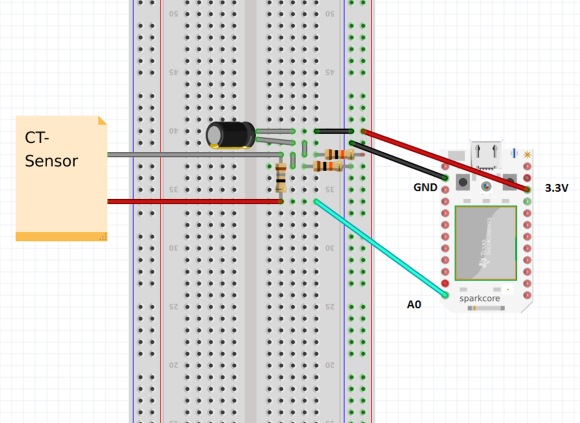
The back end is Web Application hosted on a LAMP (Linux Apache MySql PHP) setup. Initially it was hosted on a raspberry pi on a LAN, but then I decided to host it on a hosted server. Both instances worked well, its just a matter of preference.
The spark core simply takes periodic readings and sends them to the server, where all of the calculations and filtering is done.
For more detail: Non-Invasive Smart Electricity Meter
- How does the device connect to the power line?
A non invasive current sensor is clamped around a cable in the Mains distribution unit without requiring any wiring. - Can I build this project at home?
No, you should not try this at home as the Mains Distribution Unit should not be tampered with unless one is Licensed to do so. - What technology stack powers the backend?
The back end is a Web Application hosted on a LAMP setup consisting of Linux, Apache, MySQL, and PHP. - Where can the application be hosted?
It was initially hosted on a Raspberry Pi on a LAN but can also be hosted on a hosted server. - Does the Spark Core process data locally?
No, the Spark Core simply takes periodic readings and sends them to the server where calculations and filtering are done. - Is physical wiring required for the sensor installation?
No, wiring is not required as the sensor is clamped around an existing cable. - Who is qualified to work on the distribution unit?
Only a Licensed individual should tamper with the Mains Distribution Unit.
