
Summary of MULTIPHASE OSCILLATOR WITH 40% SPREAD SPECTRUM FREQUENCY MODULATION AND 250KHZ OUTPUT FREQUENCY
This project is a low-power, precision multiphase oscillator using the LTC6902, providing programmable 2/3/4-phase outputs, a selectable divide-by (1/10/100) jumper, and spread-spectrum frequency modulation. Default output is 250 kHz with 40% spread; master frequency set by R1 (RSET) and spread amount set by R3 (RMOD). Power is 5 V DC; PCB is 20.16 x 15.88 mm. Jumpers J1 and J2 configure divider and phase mode respectively.
Parts used in the Multiphase Oscillator Project:
- LTC6902 precision oscillator IC
- RSET resistor R1 (example 20 kΩ)
- RMOD resistor R3 (example 10 kΩ)
- Jumper J1 (frequency division selector)
- Jumper J2 (phase mode selector / Ph Pin jumper)
- Power input connector for 5V DC
- PCB sized 20.16 x 15.88 mm
- Output connectors or pins for 4 phase outputs
This is a precision, low power, and easy-to-use oscillator that provides multiphase outputs. The output frequency of the project is set to 250Khz, with 40% spread spectrum. The oscillator frequency can be set by resistor R1, and the spread spectrum can be changed using R3.
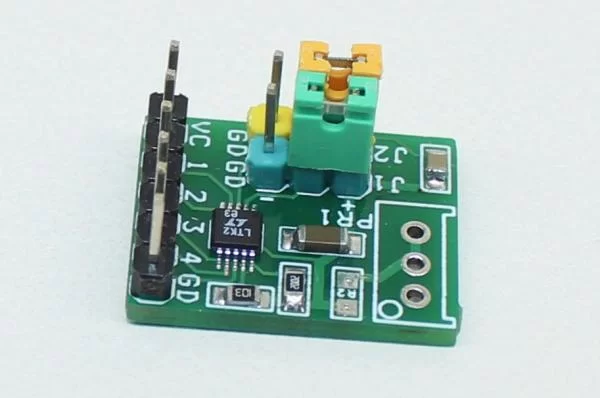
The master oscillator is controlled by the RSET resistor R1 and has a range of 100khz to 20Mhz. In order to accommodate a wider output frequency range, a programable divider, (divide by 1, 10, 100) is included and can be set using jumper J1. The integrated programmable multiphase circuit provides either 2, 3, or 4 phase waveforms. The LTC6902’s SSFM capability modulates the oscillator’s frequency by a pseudorandom noise (PRN) signal to spread the oscillator’s energy over a wide frequency band. This spreading decreases the peak electromagnetic radiation level and improves electromagnetic compatibility (EMC) performance. The amount of frequency spreading is programmable by a single additional external resistor R3 (RMOD). Refer to 4 Phase output waveform diagram.
FEATURES
- Power Input 5V DC
- Default Output Frequency 250Khz
- Default Spread Spectrum 40%
- Jumper for Frequency Division
- Jumper for Multiphase Mode
- 4 Phase Outputs
- PCB Dimensions 20.16 x 15.88 mm
Example: 4 Phase, 250Khz Clock with 40% Spreading
- Connect Ph Pin Jumper J2 to VC= Selects 4 Phase Mode, M=4
- Leave Jumper J1 Open N=10 Division
- RSET(R1) =20KOhms Sets F-Out=Fmax=250Khz
- Rmod(R3) =10Kohms Sets the Spreading to 40%
Multiphase Mode, Setting M
- 2-Phase: Connect Jumper2 to GND M=1
- 3-Phase: Leave Jumper J2 Open M=3
- 4-Phase: Connect Jumper J2 to VCC M=4
Choosing Programmable Divider Setting (Frequency Divider Setting Jumper J1)
- Jumper J1 Connect to GND = 2.5Mhz Output Frequency
- Jumper J1 Leave Open = 250khz Output Frequency
- Jumper J1 Connect to VCC = 25Khz Output Frequency
Read more: MULTIPHASE OSCILLATOR WITH 40% SPREAD SPECTRUM FREQUENCY MODULATION AND 250KHZ OUTPUT FREQUENCY
- How is the output frequency set?
The master oscillator frequency is set by the RSET resistor R1. - How is the spread spectrum amount changed?
The spread spectrum amount is set by the RMOD resistor R3. - Can the project provide multiple output phases?
Yes, the integrated programmable multiphase circuit provides 2, 3, or 4 phase waveforms. - How do you select 4-phase mode?
Connect the Ph Pin jumper J2 to VCC (VC) to select 4-phase mode (M=4). - What are the jumper J1 settings for output frequency?
J1 to GND gives 2.5 MHz, J1 open gives 250 kHz, and J1 to VCC gives 25 kHz output frequency. - What is the default output frequency and spread?
Default output frequency is 250 kHz with 40% spread spectrum. - What supply voltage is required?
The project uses a 5 V DC power input. - What R1 and R3 example values yield 250 kHz and 40% spreading?
RSET R1 = 20 kΩ sets 250 kHz and RMOD R3 = 10 kΩ sets 40% spreading in the example.