
Summary of Miniscope v2f
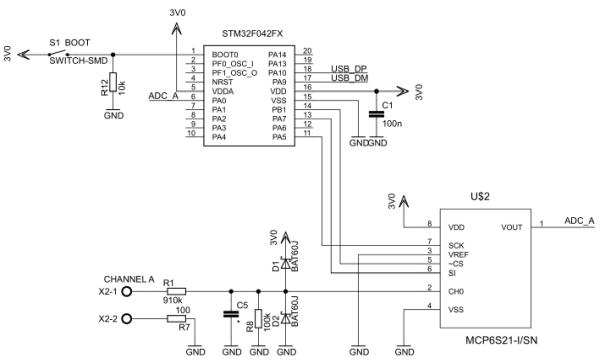
Extremely cheap low-speed PC/USB oscilloscope based on STM32F042, a miniscope v2e variant with added MCP6S21 programmable gain amplifier to fix STM32F042 input leakage and increase input impedance. Streams 8-bit, 480 kSps data via USB FS to PC GUI/DLL, offers 8 voltage ranges, ~1 MΩ input resistance, ~23 mVpp noise, record lengths from 4k to 1M (single screen) and up to 512M continuous to file, DFU firmware loading, and minimal BOM on a single-sided PCB.
Parts used in the Extremely cheap low-speed PC/USB oscilloscope:
- STM32F042Fx microcontroller (MCU)
- MCP6S21 programmable gain amplifier (PGA)
- MCP1700 voltage regulator
- mini-USB socket
- Passive SMD components (resistors, capacitors, etc.)
- Single-sided PCB
Extremely cheap low-speed PC/USB oscilloscope with STM32 (STM32F042) microcontroller – variant of miniscope v2e with input amplifier (MCP6S21 PGA) added. This is minor update, but input PGA fixes problem with input leakage of STM32F042 allowing increasing input impedance at the same time.
 Quick specification
- follows miniscope v2a-d idea: very simple device streaming data in real time to PC; DLL and GUI (Win32) are handling all the functionality,
- sampling: 480 kSps, 8 bit, streaming via USB FS with libusb (32/64bit) used as driver,
- 8 voltage ranges (0..30V, 15V, 7.5V, 6V, 3.75V, 3V, 1.87V, 0.94V – PGA x1, x2, x4, x5, x8, x10, x16 and x32 respectively),
- input resistance: 1MOhm,
- noise: ~23mVpp (visible at two gain ranges with high sensitivity),
- record length: 4k to 1M defined in DLL (single screen); up to 512M samples (continuous!) when recording to file,
- firmware loading via USB (DFU bootloader embedded in ROM),
- low component count: MCU, voltage regulator, mini-USB and few passive SMD components on single-sided PCB.
BOM
Retail prices are from my local distributor, YMMV but listed prices are rather in top range.
- STM32F042Fx (MCU): $2 retail, $1 volume
- MCP6S21 (PGA): $1.40 retail, $0.80 volume
- MCP1700 (voltage regulator): $0.50 retail
- mini-USB socket: $0.55 retail
- other: < $2
For more detail:
Miniscope v2f
- What microcontroller is used in this oscilloscope?
The oscilloscope uses the STM32F042Fx microcontroller. - How is the input leakage problem addressed?
Input leakage is addressed by adding the MCP6S21 programmable gain amplifier (PGA). - What is the maximum sampling rate and resolution?
The device samples at 480 kSps with 8-bit resolution. - How does the oscilloscope stream data to the PC?
Data is streamed in real time via USB FS using libusb to a DLL and Win32 GUI. - What voltage ranges does the oscilloscope support?
It supports eight ranges: 0..30V, 15V, 7.5V, 6V, 3.75V, 3V, 1.87V, and 0.94V corresponding to PGA gains x1, x2, x4, x5, x8, x10, x16, and x32. - What is the input resistance?
The input resistance is 1 MOhm. - How much noise does the device exhibit?
Measured noise is approximately 23 mVpp, visible at the higher sensitivity ranges. - What record lengths are supported?
Record length is defined in the DLL from 4k to 1M samples for a single screen, and up to 512M samples when recording to file. - How is firmware loaded onto the device?
Firmware is loaded via USB using the DFU bootloader embedded in ROM. - What are the main components on the PCB?
The PCB includes the MCU, voltage regulator, mini-USB connector, the PGA, and a few passive SMD components.