
Summary of 3-Switch Mini IR Remote Control for PIC10F200
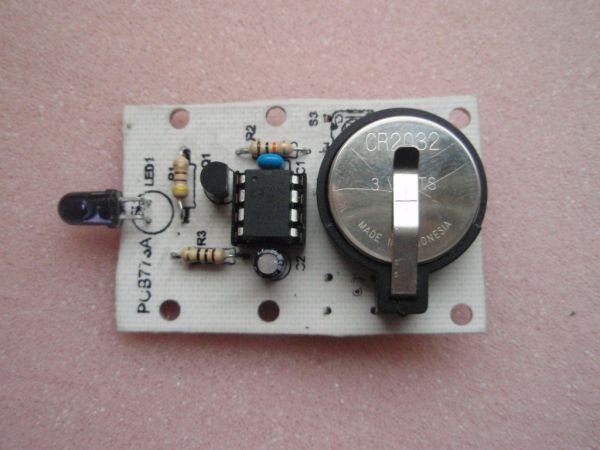
This 3-button mini IR remote uses a PIC10F200 microcontroller to transmit 12-bit SIRC signals compatible with Sony devices. Powered by a CR2032 battery, it features ultra-low sleep consumption and drives an IR LED via a transistor for a range of up to 8 meters. The design is simple, cheap, and includes all necessary firmware for construction.
Parts used in the 3-Switch Mini IR Remote Control:
- PIC10F200 microcontroller
- CR2032 3 volt lithium coin cell
- Three switches
- Transistor Q1
- 950nm Infra Red LED (LED1)
Description
This project is a 3 button mini IR remote control which transmits 12-bit SIRC IR signals as used by Sony remote controls. It has been designed to work with both the 2-channel relay driver board and 3-channel relay driver board projects also on this website.
The board uses Microchip’s low cost PIC10F200 microcontroller along with a handful of easy to find components making it very cheap to construct. Everything you need to know to build this project, including the firmware code is right here on the project page.
Circuit Description
The circuit is very simple. IC1 is a PIC10F200 microcontroller programmed with firmware to generate a 40Khz carrier modulated with SIRC formatted data. The three switches are each assigned a different command code that the firmware will transmit via the IR LED when the switch button is pressed. The whole unit is powered from a CR2032 3 volt lithium coin cell. When no button is pressed the microcontroller goes to sleep where it consumes around 100nA (0.1μA). If left unused the battery should last for many years.
When a button is pressed the microcontroller wakes and sends a SIRC device/command sequence by driving transistor Q1 which in turn operates LED1, a 950nM Infra Red LED. The transistor is used to drive around 100mA through LED1 giving a range of 7 or 8 metres.
The SIRC data is sent in a burst repeated every 45mS while the switch remains pressed. The signal modulates a 40Khz carrier with a 24% duty cycle. In the screen shot below you can see the data bursts (top) and the 40Khz carrier (bottom)
This images shows the 2.4mS start burst, followed by a 1.2mS burst, then six 600μS bursts (the command code 0000001 sent LSB first), then another 1.2mS burst followed by four 600μS bursts
(device id 00001 again sent LSB first)
For more information on the SIRC infrared protocol see:

For more detail: 3-Switch Mini IR Remote Control for PIC10F200
- What type of signals does this remote transmit?
The project transmits 12-bit SIRC IR signals as used by Sony remote controls. - Can this remote work with other relay driver boards?
Yes, it has been designed to work with both the 2-channel and 3-channel relay driver board projects. - How much power does the microcontroller consume when sleeping?
When no button is pressed, the microcontroller consumes around 100nA or 0.1μA. - What is the operating range of the IR LED?
Driving around 100mA through the LED gives a range of 7 or 8 metres. - How often is the SIRC data sent while a switch is pressed?
The SIRC data is sent in a burst repeated every 45mS while the switch remains pressed. - What carrier frequency does the circuit generate?
The microcontroller generates a 40Khz carrier modulated with SIRC formatted data. - Is the firmware code available on the project page?
Yes, everything needed including the firmware code is provided right on the project page.
