
Summary of Hot rods keep the die cool
This article discusses Texas Instruments' HotRod QFN packages, which improve upon standard QFNs by offering easier visual inspection and repair compared to BGAs. Unlike thermally enhanced packages with bottom pads that obscure joints, the HotRod design features solder lands on all sides. Internally, it mounts the die on a copper lead frame to eliminate power wire bonds, enhancing electrical and thermal performance while minimizing parasitic radiation.
Parts used in the HotRod QFN Package:
- Solder lands on all sides
- Power buses
- Copper lead frame
- Die
Quad Flatpack No leads (QFN) packages offer at least one advantage over Ball Grid Array (BGA) packages: because the electrical connections are partly made via solder lands on the side of the component visual inspection of solder joints and repairing them is easier. Thermally enhancing a package for power applications can be done with a heat conducting pad underneath, but this makes visual inspection difficult. Fortunately other solutions exist.
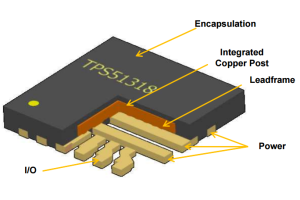
Texas Instruments’ HotRod QFN is a thermally enhanced plastic package with solder lands on all sides as well as power buses for enhanced current carrying capability. Inside the package the die is mounted on a copper lead frame which eliminates the power wire bonds, improving electrical and thermal performance. This technique also improves application efficiency and minimizes package parasitic radiation.
For more detail: Hot rods keep the die cool
- What advantage does QFN offer over BGA packages?
Electrical connections are partly made via solder lands on the side, making visual inspection of solder joints and repairing them easier. - Does adding a heat conducting pad underneath make visual inspection difficult?
Yes, thermally enhancing a package with a heat conducting pad underneath makes visual inspection difficult. - How does the internal construction of the HotRod QFN improve performance?
The die is mounted on a copper lead frame which eliminates power wire bonds, improving electrical and thermal performance. - Can the HotRod QFN handle high current applications?
Yes, it includes power buses for enhanced current carrying capability. - Does the HotRod technique minimize package parasitic radiation?
Yes, this technique minimizes package parasitic radiation. - Are there solder lands on all sides of the HotRod QFN package?
Yes, the HotRod QFN has solder lands on all sides. - Why is repairing solder joints easier in this package type?
Because the electrical connections are partly made via solder lands on the side of the component. - What material is used inside the package to mount the die?
A copper lead frame is used to mount the die inside the package.