
Summary of Almost perfect light from the Oslon Square LED
The article explains that objects emit a spectrum based on temperature (black body radiation), with peak wavelength shifting with temperature. The Sun approximates a black body, and an object's color (correlated color temperature, CCT) determines perceived warmth or coolness. Despite atmospheric absorption, sunlight remains close to black body spectrum, supporting accurate color perception. Color rendition is evaluated by CRI (Color Rendering Index), where 100 is ideal; incandescent bulbs approach CRI 100 with warmer spectra. The article references the Oslon Square LED for more details on nearly perfect light.
Parts used in the Oslon Square LED:
- Oslon Square LED
- Incandescent bulb (as reference for CRI)
- Sun (as reference black body source)
When you recall to lessons of physics from your basic- or grammar-school, probably you´ve heard a term „black body radiation”. As we know, each object with a given temperature radiates in a wide range of wave lengths, while a maximum of a radiation depends on its temperature. We mention it because the Sun also operates on this “principle” and its spectrum (light) depends mainly on its surface temperature. Temperature of an object is also the most important factor influencing whether the light will be “warm” or “cold”, that´s why a term color (chromacity) temperature CCT is used.
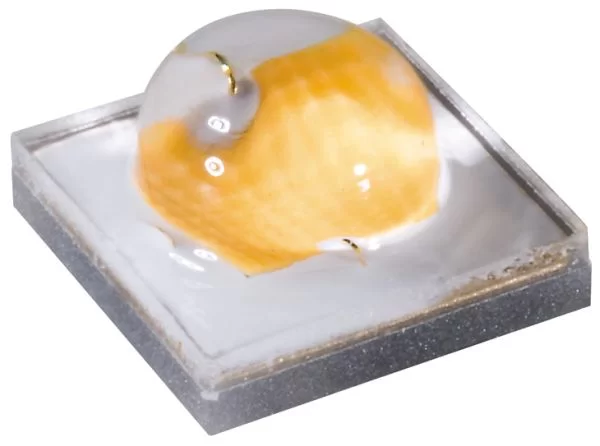
Even though a portion of radiation (some wave lengths) is absorbed in atmosphere, it can be said that it is very near to a black body spectrum and it´s ideal for us in respect to a pleasant and true color perception. There are several methods to evaluate color fidelity and one of the most important is so called CRI (color rendition index, maximum = 100). To an ideal light source with CRI =100 is very near a classic incandescent bulb, even though it´s spectrum is shifted towards warmer tones.
For more detail: Almost perfect light from the Oslon Square LED
- What is black body radiation?
It is the spectrum of radiation emitted by an object based on its temperature, with a peak wavelength that depends on that temperature. - How does the Sun relate to black body radiation?
The Sun operates close to a black body principle and its spectrum depends mainly on its surface temperature. - What determines whether light appears warm or cold?
The temperature of the emitting object determines perceived warmth or coldness, described by correlated color temperature (CCT). - Does atmosphere affect the Sun's spectrum?
Yes, some wavelengths are absorbed in the atmosphere, but the sunlight remains very near a black body spectrum. - What is CRI?
CRI is the Color Rendering Index, a measure of color fidelity with a maximum of 100. - Which light source is close to CRI 100?
A classic incandescent bulb is very near CRI 100, though its spectrum is shifted toward warmer tones. - Why is a black body spectrum ideal for color perception?
Because it provides a broad spectrum that supports pleasant and true color perception.