Summary of PIC Microcontrollers An Introduction to Microelectronics By Martin Bates E-Book
This book introduces microelectronics using the PIC16 microcontroller range, focusing on the 16F84A chip before advancing to newer devices like the 16F690. It covers programming techniques, system architecture, and application design for students and professionals. The text utilizes Microchip's MPLAB IDE and Proteus VSM software alongside standard demo hardware and custom application boards for in-circuit debugging and motor control projects.
Parts used in the PIC Microcontrollers Project:
- PIC16F84A chip
- PIC16F690 chip
- MPLAB IDE development software
- Proteus VSM interactive ECAD package
- Standard Microchip demo hardware
- Specially designed application boards
- DIZI84 Board
- DIZI690 Board
Book Introduction:
PIC Microcontrollers provides a comprehensive and fully illustrated introduction to microelectronic systems principles using the best-selling PIC16 range. Building on the success of previous editions, this third edition will enable readers to understand PIC products and related programming tools, and develop relevant design skills in order to successfully create new projects. Key features include:
-
- Initial focus on the 16F84A chip to introduce the basic architecture and programming techniques, progressing to more recently introduced devices, such as the 16F690, and comparison of the whole PIC16 range
-
- Use of the standard Microchip development software, MPLAB IDE, as well the interactive ECAD package Proteus VSM
-
- Standard Microchip demo hardware, specially designed application boards, in-circuit programming and debugging
-
- Basic interfacing, motor drives, temperature control and general control system applications
- Numerous fully documented code examples which can be downloaded from the companion website
The book is aimed principally at students of electronics on advanced vocational and undergraduate courses, as well as home enthusiasts and professional engineers seeking to incorporate microcontrollers into industrial applications.
-
- A focus on the 16F84A as the starting point for introducing the basic programming principles and architecture of the PIC, progressing to newer chips in the 16F range, in particular the 16F690, and Microchip starter kits
-
- How to use the free Microchip development environment MPLAB IDE, plus Proteus VSM interactive electronic design software, to develop your own applications
- Numerous fully-documented, working code examples downloadable from the companion website
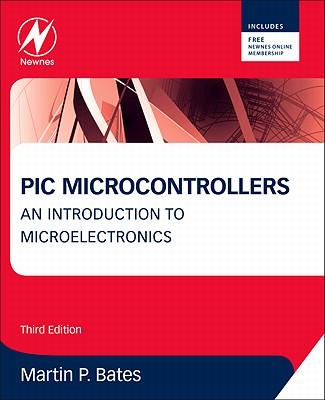 Introduction to Microelectronics
Audience: Professional
Format: Paperback
Language: English
Number Of Pages: 456
Published: 2nd September 2011
Publisher: Elsevier Science & Technology
Dimensions (cm): 23.4 x 19.3 x 2.2
Weight (kg): 0.91
Table of Contents:
| Preface | |
| Introduction | |
| Computer Systems | |
| Microcontroller Operation | |
| A Simple PIC Application | |
| PIC Program Development | |
| Internal Architecture | |
| Programming Techniques | |
| Development Systems | |
| Application Design | |
| Program Debugging | |
| Hardware Prototyping | |
| Motor Applications | |
| More PIC Microcontrollers | |
| More PIC Applications | |
| More Control Systems | |
| Binary Numbers | |
| Microelectronic Devices | |
| Digital Systems | |
| DIZI84 Board | |
| DIZI690 Board | |
| References & Links | |
| Index | |
| Table of Contents provided by Publisher. All Rights Reserved. |
Link to Purchase E-Book:
PIC Microcontrollers An Introduction to Microelectronics By Martin Bates E-Book
- What is the primary focus of this book?
The book provides a comprehensive introduction to microelectronic systems principles using the PIC16 range. - Which chip is used as the starting point for basic programming?
The 16F84A chip is initially focused on to introduce basic architecture and programming techniques. - How can readers develop their own applications?
Readers use the free Microchip development environment MPLAB IDE plus Proteus VSM interactive electronic design software. - Does the book cover motor drives and temperature control?
Yes, it includes basic interfacing, motor drives, temperature control, and general control system applications. - Are code examples available for download?
Numerous fully documented code examples can be downloaded from the companion website. - What specific boards are mentioned in the table of contents?
The DIZI84 Board and DIZI690 Board are listed in the contents. - Who is the intended audience for this book?
The book targets students on advanced vocational and undergraduate courses, home enthusiasts, and professional engineers. - What tools are used for in-circuit programming and debugging?
Standard Microchip demo hardware and specially designed application boards are used for these tasks.