


Summary of ELECTRONIC KEY WITH PIC16F84 AND DALLAS IBUTTON
This article describes an electronic key system using a PIC16F84 microcontroller and Dallas iButton components. The iButton, resembling a button cell, contains a unique ROM chip that communicates via two electrodes for power and data. The system ensures security by reading the device's serial ID through a specific command sequence. A schematic and source code are available for download to implement this project.Parts used in the Electronic Key with Pic 16F84 and Dallas iButton:
- PIC16F84 microcontroller
- Dallas iButton (Button Key)
- Diode network
- Capacitor
- MOSFET output
Electronic key with Pic 16F84 and Dallas iButton They are called Button Key and innovative components are made by Dallas Semiconductor, externally arise as button cells with a diameter of about 16 mm thick and 5 contain a microchip... Electronics Projects, Electronic key with Pic16f84 and Dallas iButton "microchip projects, microcontroller projects, pic assembly example, pic16f84 projects,
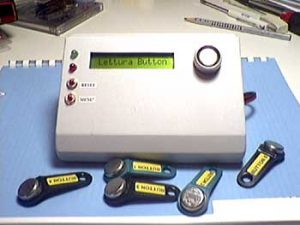
Electronic key with Pic 16F84 and Dallas iButton They are called Button Key and innovative components are made by Dallas Semiconductor, externally arise as button cells with a diameter of about 16 mm thick and 5 contain a microchip connected externally to the two electrodes, which is positive.
They are the two electrodes for feeding, through which propagate the data: in practice once fed the chip generates all the bits that characterise it in serial form, producing a series of logic levels but not distort the functioning .
This thanks to a network diode and capacitor that takes tension at rest and during high levels, isolating when the electrodes are closed since MOSFET output. Also among the leaders of the “button” is a logic that leads impulses to the control, to receive commands from the bus to two wires. The models available are different and with a broad range of functionality.
Within the iButton is a uniquely programmed ROM at the time of construction with a precise laser technique, so as to ensure maximum security of the system. To read it is necessary to feed the device and send the form of commutations along the power line, the command READ ROM: Key Button responds by issuing serial form in what it contains, from the bit whose address is less significant.
PIC16F84 DALLAS IBUTTON KEY

Electronic key with Pic16f84 and Dallas iButton schematic pic assembly source code
FILE DOWNLOAD LINK LIST (in TXT format): LINKS-2513.zip
Source: ELECTRONIC KEY WITH PIC16F84 AND DALLAS IBUTTON
Quick Solutions to Questions related to Electronic Key with Pic 16F84 and Dallas iButton:
- What is the physical appearance of the Dallas iButton?
Externally they arise as button cells with a diameter of about 16 mm thick. - How many electrodes does the iButton contain?
The component contains a microchip connected externally to two electrodes. - How is the data transmitted through the iButton?
Data propagates through the two electrodes which serve for feeding and communication. - What ensures maximum security in the iButton system?
A uniquely programmed ROM created at construction time with precise laser technique ensures security. - What command is sent to read the iButton data?
The command READ ROM must be sent along the power line to read the device. - How does the iButton respond to the read command?
The Key Button responds by issuing the contents in serial form starting from the least significant bit. - What components isolate the circuit when electrodes are closed?
A MOSFET output isolates the circuit when the electrodes are closed.
Related projects
PIC Stepper Motor Controller using PIC16F84A with Proteus Simulation
Introduction Stepper motors are widely used in embedded systems and DIY electronics projects where precise position control is required. This PIC Stepper...
Programmers & ICSP · PIC16F84APIC Musical Doorbell using PIC16F84A with Proteus Simulation
IntroductionThis microcontroller project demonstrates a musical doorbell built around a PIC16F84A and a simple piezo sounder.Using two push buttons, the system allows...
Beginner Tutorials · PIC16C84Exploring the World of PIC Microcontrollers: An Architectural Overview
A Peripheral Interface Microcontroller (PIC), developed by General Instruments Microcontrollers in 1993, operates under software control and is programmed to execute various...
Home Automation & SecurityVoice Activated Power Sockets (Home Automation)
Yet another voice controlled home automation system! As shown in the picture, the system can control any electrical appliance, by turning ON...
Home Automation & SecurityHome Security System with GSM Using 8051 Microcontroller
Security is a big challenge everywhere because thefts are increasing day by day owing to the unsafe and insecure security systems in...
Home Automation & SecurityHome Automation and Security System using Microcontroller ATMEGA8 with Arduino Programming
Home automation and security systems have become very popular these days, today industrial automation techniques are widely adopted by luxurious homes and...

Muhammad Bilal
I am a highly skilled and motivated individual with a Master's degree in Computer Science. I have extensive experience in technical writing and a deep understanding of SEO practices.